

 Android & iPhone
Vitalik ' s latest presentation: Technological paradigm shift over the last 15 years and the future of the Ethera

Jinse Finance
2026/09/23 11:13 100K
On September 23, the Shanghai blockchain International 12th Global Summit took place. The summit brought together the world’s top blockchain founders, technology leaders, investors and policymakers to focus on the cutting edge of industry technological breakthroughs and business practices, and to explore in depth core issues such as integration of AI with the blockchain, the large-scale application of Web3 and regulatory science and technology.
The keynote address was given by Vitalik Buterin, founder of the Taifung Coalition, on the theme of paradigm shifts in blockchain technology over the past 15 years, zero proof of knowledge integration with AI, road map for future Taifeng agreements and their adaptationVitalik points out that the Ether is moving from a simple blockchain to a larger network with different layers.He stressed the key role of AI in reducing certification costs, increasing code security and accelerating formalization verification. He predicted that future technology would be fully integrated into front-line technologies such as STARKs with a rigid fork in the Taifeng region, and called on developers to re-engineer applications using new features.
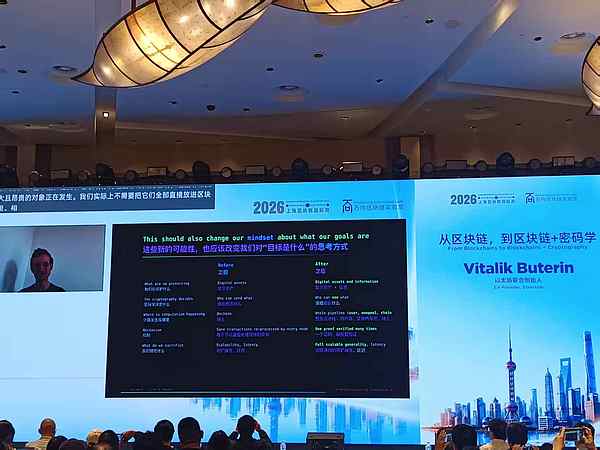
The following is a transcript of the keynote address by Vitalik, compiled and edited by the Gold Book and deleted.
Today I would like to talk about a more macro topic. We have been talking about the Ether and friends for over 15 years. I also know that Shanghai, Ether and related activities have been going on for more than 10 years. Bitcoin was born in 2009. On the surface, the tools and technologies we're building still seem to be similar, but in fact, there has been a lot of change over the past 15 years.
And one of the reasons for these differences is that, as users, the attributes you acquire and the costs you have to pay are very different from what we thought 10 or 15 years ago. Even how we think about rules has changed.
Fifteen years ago, the blockchain was our most important technical tool. Bitcoin combined the blockchain, signature and proof of workload. The ETA subsequently joined the smart contract and turned to the equity certificate in 2022. These were the ideal tools for what we were working at that time. The zone chain brought with it the attributes of openness, participation by anyone, free, mobile, reliable, secure and neutral. No centralist actor could interfere with your application, stop it or give it the wrong answer.
But public block chains also have costs. In the past, it was often said that public block chains are like twittering your name. In 2009, people thought that as long as a person’s name is not directly attached to the transaction, it is rather private.
At the same time, people want to do more with block chains. They want more performance, not only interested in payments, but also, even if they do, that they have stronger and stronger attributes of their own. So we really want to go further, and I think we can do it in many ways.
Zero proof of knowledge: the revolution in certification
One of the biggest technological changes in the last 10 years has been the rise of zero-knowledge proofs. This includes ZK-SNARKs, as well as antiquity versions of STARKs. These objects are designed to enable you to validate calculations.
A person runs a calculation and then produces proof. Others validated this calculation, but the certification process was much more efficient than re-executing it. At the same time, a certifier does not even need to know the complete information about entering the calculation. One of the core elements of blockchain technology is the question of certification: we want the system to give every participant confidence that what is happening follows the rules. The initial technical programme was for everyone to re-enforce. This is at the expense of privacy and scalability. And Snarks and STARTs changed both points.
I've been talking about this for more than a decade, but it's closer to reality every year. I think the major change this year is that all plans are moving towards using these technologies. They're not part of the distant future, but have become EIP, date and project routes. Maybe within two years, even because AI accelerates sooner. After the hard crosses in the future, much will be put into STARK.
More front-line cryptographic technology.
There are other, more powerful technologies that are emerging than ZK. For example, universal encryption, and perhaps indistinguishable confusion. These techniques have long been thought to be remote, but in fact some versions may become feasible faster than many would imagine.
These more powerful technologies will bring many capabilities. For example, you can have parallel block chains, which begin even before the transaction is included in the block. FOCIL is an example: for the first time in the Ether Workshop, multiple participants have joined together to build blocks. The blocks are no longer created by one participant alone. There are 16 inclusion list creators, and last one final builder. The objective is to provide stronger assurances that if you send a transaction, it will enter the next block and not be left at the discretion of a single actor.
Apart from FOCIL, there are blobs after EIP-4844. blobs are large and simple objects. We don't put all blobs directly into the chain, but we can aggregate them under it. This process occurs before you send a transaction. It replaces a large number of objects with a group of blobs. There are many similar changes in the technology of the hawk.
What are we protecting?
These changes allow us to rethink the role of the system.The first big question is: What are we protecting?
Bitcoin protects a digital asset: BTC. ETA says you can release your own digital assets, and we can protect it.. Modern cryptography protects digital assets and information in bitcoin and the Ethers, usually the answer is: who can put what, when, to whom.
Now, we're entering a programmable privacy era. The code determines who can see what. The question is not just "Can you send it," but "Can you see something?" It's becoming programmable.
The second question is: where does the calculation take place?
Fifteen years ago, almost all calculations occurred on the chain. Five years ago, the situation has changed considerably. And now, this change is accelerating. We are moving from a point of view with only block chains to that of a full-flowing waterline, complete coded network.
In this network, users do a lot of local calculations; then the transaction goes through mempool, which has various types and different privacy attributes; then the transaction is co-opted into multiple blocks to build participants; then the transaction is chained up. In bitcoin mechanisms, the same transaction will be reprocessed at each node. In the Etherport, a blob can also be verified many times.
In the end, what did we sacrifice?
Bitcoin is another example. It sacrifices scalability and delays. The centralization system can provide 100 milliseconds of delay, sometimes 300 milliseconds worldwide. Bitcoin is about 600 seconds, or 10 minutes. The current slot at the Etherport is about 12 seconds and its finality is about 15 minutes. But in the future, it is expected to drop to 4-8 seconds and finality to 832 seconds.
In terms of scalability, one major change is that blockchain structures no longer always need to be sacrificed at the expense of scalability. It does not sacrifice expansiveness, but rather some scalability. If you do not give the system any assurance as to what calculations are doing, if they can be packaged as parts that can be executed alone, independently validated, or even operated before the chain is up, expansionability becomes possible.
If you see a blockchain as the whole system, it's L1, and it's also L2, rollup, and so on. They all become very complex middle layers. You or your agent can decide which parts to go, and many calculations can happen in them. We used to talk about logic, we talked about code safe calculation. We're turning computing into a code world computer.
The trade goes through these layers, and eventually there's still a chain. But the role of the chain is minimized. The chain does not deal with everything anymore. The chain deals only with business logic that must be dealt with in a series of lines at each nodes. This part becomes much smaller because everything else can be done outside the chain.
AI is accelerating everything.
All of these changes are possible thanks to AI in large part. We have to give it a big credit. Even my slides are not so ugly, and thank AI. Basically, every part of the workflow is being speeded up by AI.
Before AI, we had zero proof of knowledge, but only relatively simple password applications. One reason is that if the number of code lines exceeds about a thousand lines, there will almost certainly be bugs in it. Now, we can use different types of redundant testing, regulation and analysis. In the post-AI era, we can put more things into code science, doing bigger, more complex things.
Algorithms used to be very expensive. Now, 100 times or even lower costs are often possible. For ZK, we have been able to do less than 10 times in AI reasoning, and some Hashi types are also below 10. Proof that generation may still be 250 times more expensive, but it is improving quickly. Formatting certification was another major practical bottleneck.
I believe that a major constraint to L2's failure to achieve the desired results is its limited ability to verify. You need redundancy, multiple certification systems and a security committee. Now, you can have a variety of norms, one thing, or different people, different agents, different teams to describe the work being done in different ways, and then you can automatically prove with math that they're talking about the same thing. If they end up saying different things, you can narrow the controversy down to a smaller base and make it easier for everyone to judge which side is right.
The Etherwood Road Map and Opportunities for Developers
The ETA world is making great progress on the protocol and application levels. I encourage you to look at the ETA road map and related protocols. Each hard fork in the next year will involve the SATK character: putting everything into a zkeEVM, aggregating STARK, verifying everything, signing quantum algorithms, etc.
Putting all of this together, the Ether Workshop is moving from a simple chain of blocks to a larger network with different layers. One advantage of AI is that it not only helps us build these things faster and safer — if we really choose security — but also makes them easier for anyone here to understand.
So, if there are developers or researchers here, I very much encourage you to try to understand what different parts of this ecology are building, understand the attributes of different parts, and see if there is an output, a part that you want to be involved in, or contribute to. I think it's becoming more possible, and more accessible, to engage in this frontier technology and ecology. You can help us, research, build, and help build as long as you are willing to work, think and invest.
There are now open competitions around improvements and formalization. At the same time, it is a good time to rethink applications. Many applications that were built on the Ether House five years ago, 10 years ago, 15 years ago, were not designed in the context of "programmable privacy becomes possible" with "the security of complex codes can be verified."
I encourage you to go back and develop, build and integrate applications with other decentrized networks and the real world. I want to promote improvements and innovation.
Thank you.

 7

Declaration: This is a gold original, the copyright is a gold one and cannot be reproduced without authorization. A copy of this article must be downloaded from an agreed-upon medium with the indication "Source: Gold Book", for which the offender will be held liable under the law.
This information is not a financial investment proposal.
 Save



- Pantera's latest status report on monetization.
- What game is AAVE playing next?
- US SEC issues an update of the crypto asset FAQ to add a new issuer's currency buyback definition
- QNT surged over 300% a week, currency deposits infiltrated the core of the United States banking system?
- Vitalik's latest post: The Ether Workshop will become a password-based world computer.
24-hour text


 After $387.5 million was stolen, Bitget and thorchain got in a fight.
Conflux Tree Map blockchain
 How did the harvest line at the Meme Factory come out of the water, Robinwood Chain?
Chain catcher ChainCatcher
 Bitcoin goes into shock and waits for a new catalyst?
Knight of the Zone Chain.


 US SEC Committee member: Is the more regulatory data collection the better?
Asia-Pacific Future Study
- Seeking coverage
- Jinse Finance AppiOS & Android
- Community
Telegram - Feedback
- Back to Top
- Back to Bottom
Listen to Jun's words and read a book for 10 years. I wish I could have seen it earlier.