

 Android & iPhone
How did the harvest line at the Meme Factory come out of the water, Robinwood Chain?

Chain catcher ChainCatcher
Just now
Author: Zhou, ChainCatcher
On 22 September, the token Deed opened on Pons, the coin platform of Robinhod Chain, evaporates more than 90 per cent of its market value in less than a day.
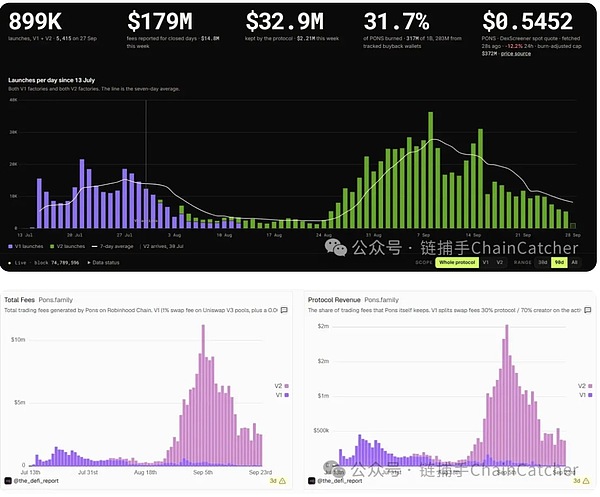
Robinhod Chain has been one of the most active currency outlets in the world since July. According to Pons ledger, the Pons alone have issued almost 900,000 tokens. At this point, a new coin crashes are not new.
However, the chain analyst followed the funds of the DeED upwards and found that the same group had been linked for about two months to dozens of coins issued, drawing a cumulative sum of about $18.43 million. Here's how they work.
I. Proceeds from the previous harvest, to be paid for the next round
DEED claims to be a real estate bank on Robinhod Chain, claiming that the holder can share in rental income after a combination of flats less costs. On September 22nd, DEED opened on Pons, with a market value of $4.23 million at one point.
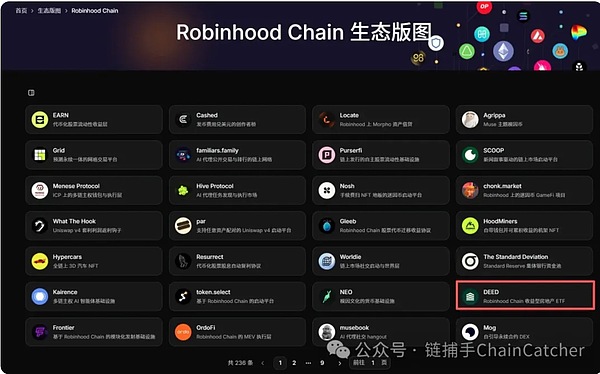
However, the heat remained in place for less than a day. On 23 September, Onchain Lens monitored that DESED was suspected to have occurred in Rug Pull. At one time, the associated wallets controlled the supply of approximately 86 per cent of the coins and drew some $700,000 in funds. The founders also received 68.5 ETH creator fees valued at about $1889 million. At this time, the market value of DESED has fallen to about $55,000, a decline of 98.7 per cent over peaks.
According to the chain analyst Wazz, DESED is not an isolated event. It is financed by another token previously issued by the same group of people.
The story starts with the DRAFT one week ago. On the evening of September 14, 98 wallets holding DRAFT were transferred to the same address in three seconds, and the money was then transferred as a whole to a wallet starting with 0x9d06, where it stayed for a week.
In the early morning of September 22, this money began to prepare for the start-up of the Deed. 0x9d06 first turned out 50 ETH, two minutes later 20 ETH came to the purse of the DeED. 16 seconds later, the wallet was transferred in bulk to 50 addresses, and the founders of the Deed and 25 previously set aside as a platform for protection against sniper taxes were all among them.
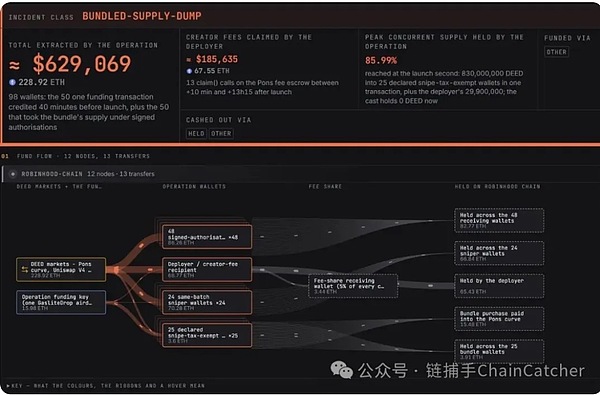
After 40 minutes, DEED opens. The first buy-in is made for the 25 free wallets. When the purchase is completed, the founder and the wallet already hold approximately 86% of the supply.
After a second, they started selling, and the chips were spread over more wallets. By the time Onchain Lens warned, the harvest had been completed.
The connection between DRAFT and DEED is just a microcosm. Wazz found that the same rhythm was repeated over and over two months.
Each time the group issues a coin, it prepares dozens of wallets and puts them on the tax-exempt list. Once the token is in line, the wallets take most of the chips within one or two blocks.
Wazz is following this chain of funds, which brings together 45 distributions. In addition, four start-ups were issued with the same private key and four sales proceeds were remitted to the same collection address. Finally, 53 distributions from 10 July to 21 September were placed in the name of the same group, most of them through Pons V2.
The same name will be used repeatedly by the group in order to magnify the profits. On the same day that the fund was given, the other token, also known as DEED, was financed. PINK, CRUMBS, and DEED were issued three times each in about a day. Wazz believes that the group would collect the flow of preheat with the same name, then publish the real contract address.
According to Wazz estimates, the 53 issuances cumulatively drew approximately US$ 18.43 million, although this figure measured funds taken from markets by groups of people who were both dispersed and other traders and robots, which did not amount to a total of losses in the diaspora.
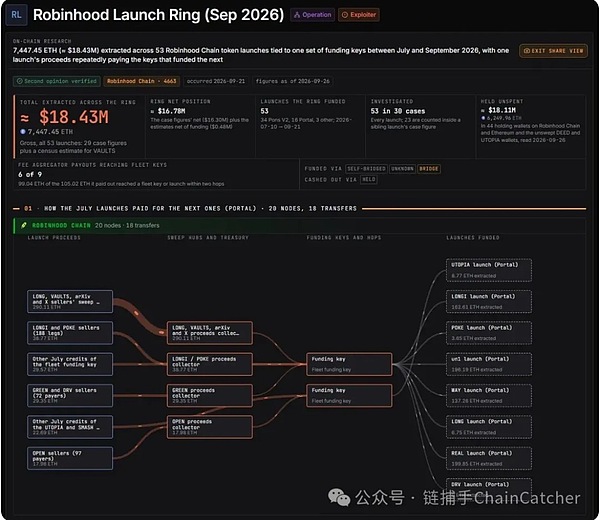
As a clue, the single size of DEED is not large. The highest withdrawals are from CRUMBS and LEGS, about $3.12 million and $2.9 million, respectively. Wazz states that most funds remain in the chain in the form of ETH, which cannot be frozen.
Two. The sniper tax stopped the robots, not the people who got their immunity in advance.
The tax-exempt list mentioned earlier is the key to this harvest being repeated. It comes from a set of rules that Pons designed to prevent robots from running.
Pons V2 enters the line, trades first on a conglomerate curve and buys more people at higher prices. After the curve is sold out, the coin automatically graduates into the Uniswap v4 pool and the liquidity is permanently locked. The Pons document shows that post-graduation tokens do not have the ability to exit mobility at all.
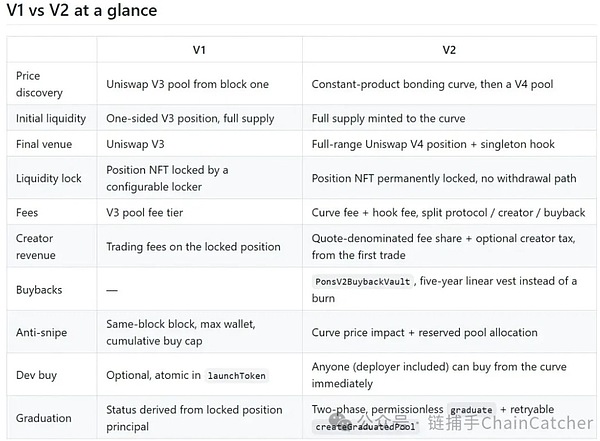
The design blocked the project's old road of moving from a pool, but it did not control who could buy chips when opening.
In the first few seconds, the new currency is most easily bought first by a starboard robot. For this reason, Pons V2 has introduced a sniper tax. When it opens, it pays up to 99% of the tax, which declines to zero in about five seconds, 25% in one second and 3% in two seconds.
The tax is enough to make robots unprofitable, and the rules leave a mouthful behind. The issuing address and the creator's fee-free address are automatically exempt, and the sender can assign an additional 32 duty-free addresses when creating a token. Pons in their files give reasons for allowing teams to spread open purchase orders across multiple wallets.
In other words, as long as the sender has written his wallet on the list in advance, it will be possible to build a tax-free warehouse in the few seconds when others are required to pay high taxes and fees.
The same pattern has been observed in the Wazz distributions nine times since the end of August. The founders, 15 to 25 wallets, exempted from sniper tax and then bought them by a trade deal, bought them out of line and pushed the coin into the Uniswap pool. When the disk was opened, the ratio of creators and duty-free wallets was between 82 and 86 per cent.
The nine openings were bought with a common denominator, all of which went through the same uncertified contract that was created on August 28th. Wazz stated that the contract belonged to a commercial bundle with many unrelated users, and had been used 25 times in 53 distributions.
In addition, he has found at least two consecutive money-sending gangs that could not be directly linked to the case.
On 28 September, the security agency GoPlus disclosed that a high-risk fraud at the Meme factory had been discovered in Robinhod Chain, with nearly 30 days running over $9 million involving hundreds of frauds.
The Meme factory has taken another route, by allocating tokens to a large number of new addresses with only 4 to 11 transactions, and then selling them through the Pons V2 support contract and the Uniswap route by-pass, creating false images of multiple independent traders.
Of the 10 samples listed by GoPlus, only 3 to 8 new wallets are used in each currency and 2 to 13 ETH is taken in a single token. The amount of money sold is not large enough to be remitted to a consolidated address and used to finance the next round.
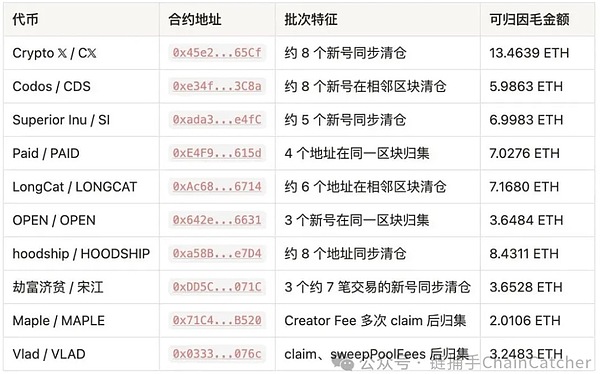
According to GoPlus, the most recent 400 transactions with this consolidated address total revenues and expenditures of approximately 3,589 ETH, or $9.49 million, which is a two-way stream of water that does not represent net profits. GoPlus notes that in both cases large amounts of wallets were used to hide true holding concentration, neither relied on the removal of ponds nor prohibited sales. There is no evidence that either group was the same group.
A large number of new wallets are not visible, because they relate to the ecology of Robin Hood Chain. According to Pons ledger, from 13 July to 27 September, Pons alone issued approximately 89.99 million tokens, which came from about 453,000 addresses. Only about 1.5 per cent of V2 coins were sold out and graduated successfully.
On September 8th, the peak of currency issues, about 90% of the approximately 27,000 addresses involved in its issuance had never been issued before. In tens of thousands of new coins and new addresses each day, dozens of one-off wallets are difficult to identify by ordinary buyers.
III. Shares of clothing and creators, making the coin a business
Looking back at the apartment vault of DEED, this type of packaging is not uncommon in group coins.
Wazz lists the tokens with the names Pink Sheets, Stock Miner, Openbell, EQUITY BROKEERS, among which Pink Sheets is the old name of the U.S. powder list market; the highest withdrawal CRUMBS claims to have been able to convert shopping tickets into stock notes.
This coat is indistinguishable from Robin Chain's own location, where it sells as a token of shares. Pons V2 also allows the issuer to price the new currency directly with shares.
GoPlus previously scanned Pons V2's currency records and found that 32 per cent of the 32.44 million currency transactions in 11 days were directly priced in official stock coins. In short, meme coins have become a common game.
JINQIAN pushed the coat to extremes. In early September, the Meme coin was put online through a privately owned coin factory in Robinwood Chain, trading for a FaMI token using Farmmi stock code. Farmmi is a mushroom supplier listed in NASDAK, named by JINQIAN from the money mushroom mentioned in his annual report.
According to Nansen, this FAMI is not an official stock token and has nothing to do with Farmmi’s shares. But the name is enough for the market to be connected.
Prior to that, GoPlus sent a Robinhod Chain risk report which showed that the entire supply of this FAMI token was in the operator’s hands. JINQIAN had only to make a match with FAMI, and every time a family buys JINQIAN, they need to buy it first from the operator. When the heat subsides, the operator withdraws about $2.06 million in stable currency.
Packaging brings buyers in, and creators split the business so that it can be done in turn.
On Pons, the bulk of each transaction’s handling fees are allocated to the coin creator. According to Pons ledger, as of September 27, Pons accumulated a fee of about $180 million, of which approximately $147 million went to the creator’s side.
For groups that issue coins on a continuous basis, this is an income other than the leverage they sell. Of the sample of GoPlus, two tokens are derived from multiple collections of creator's fees.
Finally.
According to the data, the trend of issuing currencies is retreating. According to pons ledger, Pons’ single-day currency volumes have fallen from about 36 000 on 8 September to about 5,400 on 27 September.
On September 29th, Robinhod Wallet’s Gas subsidy for chain exchange expired. These data will be meaningful only if users and transactions are retained after the subsidy is over.
On September 30, Robinhod’s annual general meeting, HOD Summit, will publish new products for active traders. The market is also waiting for its next version to land. The market expects that the new version will adjust the issuing mechanism, costs and graduation rules based on V2.
In general, Robinhod Chain was originally meant to move stock onto the chain. Successive coins and unbridled centralization techniques are rare on various chains, where they are replaced with stock and real estate clothing. As more and more ordinary investors follow this chain, it may still face old problems.

 0

Statement: The present paper was written by the author of the gold-based financial estate, whose views are expressed only on behalf of the author and in no way represents the gold-based financial system which shares his view or confirms his description.
This information is not a financial investment proposal.
 Save

24-hour text
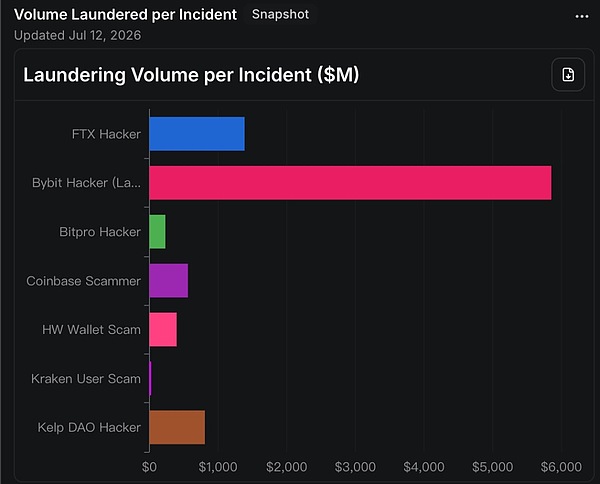


 After $387.5 million was stolen, Bitget and thorchain got in a fight.
Conflux Tree Map blockchain

 How did the harvest line at the Meme Factory come out of the water, Robinwood Chain?
Chain catcher ChainCatcher
 Bitcoin goes into shock and waits for a new catalyst?
Knight of the Zone Chain.


 US SEC Committee member: Is the more regulatory data collection the better?
Asia-Pacific Future Study
- Seeking coverage
- Jinse Finance AppiOS & Android
- Community
Telegram - Feedback
- Back to Top
- Back to Bottom