

 Android & iPhone
Eight hidden details of Anthropic's book.

GenAI Summit
5 h ago 100K
By Alan Walker of Silicon Valley
42 billion dollars in losses, 51.8 billion dollars in calculative commitments, 80 pages of risk factors.Behind these big headings are a few other lines that really deserve to be seen.
On September 28th, local time, Reuters disclosed an IPO book from Anthropic. Let's start with the nature of this document: it's not an open version of Anthropic. In June this year, Anthropic, as a pro bono company (PBC), submitted in secret to the United States SEC a draft S-1 registration declaration. It is the rule that the company must publicly present the revised version at least 15 days before the road is performed, and complete financial data will not be seen until then. Reuters saw an undisclosed version, and Anthropic refused to comment. This means that all the figures below may be revised in the official version, and read with this premise.
In the last 24 hours, the titles of the Chinese-English media are almost identical: 42 billion short, 12 times higher incomes, 51.8 billion in calculus, and warning AI that it could destroy humanity. These are true, but they're all just "covers" for stock calls. I sat in a coffee shop on Stanford campus, picking out a couple of pages of text that were omitted from the press, one by one, and telling them in big white.
Let's start with the conclusion.
Of the 42 billion net losses, 34 billion are book numbers because of "company's too valuable", and it disappears when IPO finishes.
The real target rate is "calculated expenditure, revenue.": The gradient determines the valuation from 6.6 to 1.6 times in a year.
The 51.8 billion-dollar calculator promise is a distribution form."Who gets the big contract, who's the real "partner" of Anthropic, and that sort of thing is the opposite of who invests more money."
Two clients each accounted for 12 per cent of income and had no permanent contracts- That explains why Anthropic had to do a retail product like Claude Code.
The 80-page risk factor describes 48 pages of business, and the book itself is a legally defined "safe alignment document".
In July, a sample of about 6 per cent of the research calculator was used for safety purposes.• The first security narrative has a denominator, which can be tracked every quarter thereafter.
One vote for the public share, but seven co-founder Founder LLCs have 50.1 per cent voting rights and four directors from the Long-term Interest Trust.: The public buys economic power, not control.
The book says that income depends on the "continuous, super-heavy release rhythm."And that's the deepest part of the whole story, two weeks ago.
It's over $42 billion, of which $34 billion is too valuable.
As you can see: The net loss in 2025 was close to $42 billion, which was placed under almost all headings.
Ignored: In the original line, some $34 billion is an accounting cost, reflecting an increase in the valuation of "financing instruments that may be converted to Anthropic shares in the future" rather than the money spent on company operations. The real operating loss is $8.06 billion. Cash, cash equivalents and short-term investments are recorded at year end.
Deeper: Anthropic has issued tools such as convertible instruments and SAFE in previous rounds of financing. Accounting standards require these instruments to be measured at fair value, which follows company valuations. The corporate valuation increased from 61.5 billion (March) to 183 billion (September) in 2025, and the corresponding "indebted investor's share" of these instruments is valued, with the difference recorded as a loss.This 34 billion is the shadow of anthropic valuation.The more successful the company succeeds, the more it loses its books. Likewise, in June, FT reported a net loss of about $39 billion in 2025, about $30 billion of which is a one-time cost associated with investors’ rights under the old equity structure.
After IPO is completed, the tools are converted into regular units and re-costing does not occur again. So, in Anthropic, it takes three figures instead of one: an operating loss of 806 billion (the real difference in business), a cash deficit of 20.28 billion (how long will it last) plus the May round of $65 billion (which was not included in the end-of-year cash count). This figure of 42 billion is probably explained by a special "non-GAAP adjustment" in the official book.
Common interpretation
And you agreed to pay back the shares of your company at 100 dollars. A year later, your stock was tenfold higher, and the accountant said, "You owe him a thousand dollars now, plus 900 dollars in loss." But you didn't spend any more, except that the company was worth more. And this is the 34 billion dollars.
The coefficient divided by income: from 6.6 to 1.6 times, the slope is the most important figure in the entire page.
As you can see: Budget and infrastructure expenditure amounted to $7.33 billion, or 58 per cent of the total operating costs of 12.65 billion, with a revenue of $4.59 billion - "for every dollar earned, you have to pay $1.6."
Ignored: The same calibration was put into 2024, when the ratio fell from 6.6 to 1.6 in a year. Income increased 12 times (386 million to 4.590 million), and expenditure increased by less than three times the amount disclosed. The absolute value of operating losses increased from 2.98 billion to 8.06 billion, but the relative share of income fell from about 7.7 to 176 times.
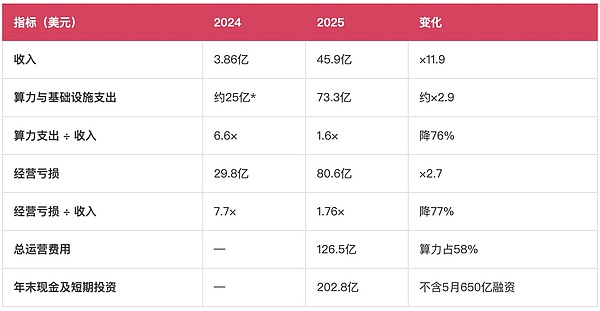
*The 2024 arithmetical expenditure is the author's reverse by applying a "6.6 times income" and the non-equity book directly discloses the figures.
Deeper: The cost structure of the forward model laboratory is completely different, and SaaS is more like a refinery: training is a one-time fixed asset input, with the reasoning being that the cost of moving with the volume, the raw materials are electricity and chips. SaaS has a natural 70%-80% Maori rate, while the economics of the refinery is thatCapacity utilization– The same GPU, full and half, double the unit cost. A sharp drop in 2025 indicates that Anthropic buys more than it buys. This is not a cost-control effect, but a result of growing demand.
One more step forward. Many media quoted data that by the end of July 2026, Anthropic had an annualized income performance rate of over $65 billion and had recorded a positive operating profit for the first time in the second quarter (the two were retransmitted from a single source and the official book would give exact figures). Assuming that the computing expenditure doubled to $15 billion in 2026, the ratio fell below 0.25. From 6.6 to 1.6 to 0.25, three orders of magnitude over three years — the investor gave a valuation of 2 trillion dollars — and bought this slope to hold.
Common interpretation
Opening a power plant, the first year of electricity is very rare and the cost of each plant is too high. Ten times more people use electricity in the second year, the plant is still the same, and the cost of every electricity comes down at once. Anthropic in 2025 was "ten times more people use electricity."
51.8 billion is not a bill. It's a distribution form for "who is the partner."
As you can see: Clouds, computing power and infrastructure obligations of $51.8 billion in the coming years are more than 100 times the revenue generated by 2025.
Ignored: This 51.8 billion represents the total value of multi-year contracts and is not a one-year budget. Distribution of public contracts organized by telecommunication technology (cautionary, direct calibre of non-equity book): Google Cloud is about 200 billion, Amazon AWS is about 100 billion, Lambda and Nscale together are about 80 billion, Fluidstack is about 50 billion, Microsoft Azure is about 30 billion, the rest is scattered among small cloud merchants, and their own infrastructure is deployed at the WULF hosting facility.
If you look at this table together with the shareholders' list, you find a contrast: Amazon has put about $8 billion in cumulative investment, Google is about $2 billion -- and Google on the arithmetic contract is twice as much as Amazon.There are fewer contracts for money and more contracts for money.And this sort of thing: Anthropic's dependence on the TPU route has outpaced that of Trainium, and it doesn't want any cloud merchant to be the only supplier - Lambda, Nscale, Fluidstack, three "new clouds" worth 130 billion, more than AWS.
Deeper: The essence of the arithmetical contract is forward option. It's locked in future income for cloud merchants, and it's "no-go" liability for Anthropic. The pricing logic of such contracts is twofold: they are too small to be signed, and the models are not sequentially numbered with machines and are out of the game; Too many signatures have been signed, and the demand has turned into a sinking cost if it does not meet expectations. So the denominator of 51.8 billion is not $4.6 billion in 2025, but the cumulative income over the term of the contract - if it actually reaches 190-200 billion in 2028 (also reproduced by a single source of information) - and 51.8 billion equals about two and a half years of income. This multiple is in the area of heavy assets such as telecommunications, aviation and so forth and is normal.
More interesting is the fact that suppliers are shareholders at the same time. Amazon and Google sell their money to Anthropic while holding its shares, so the pricing space for calculating contracts is not entirely market price – this is where the book of hires needs to be explained in detail in the section on related transactions, and it is the most worthwhile page to turn on in the official edition.
Common interpretation
An airline has booked 500 planes for a 10-year delivery period. You can't say it's going to cost 500 aircraft this year, but you have to ask: Will it sell the seats over the decade? Whoever gives it the most aircraft will tie it down the deepest - in Anthropic, here, Google is the one that ties it up the deepest, not Amazon, which invests the most.
Two clients each account for 12 per cent of the clients. The book doesn't say who it is, but what does it look like?
As you can see: Nearly a quarter of the income comes from two clients; risk factors indicate that many large customers are ready to cut or stop spending without permanent contracts.
Ignored: On the basis of $4.6 billion in income, 12 per cent means that each of the two families paid approximately $550 million to Anthropic in 2025. There are only three types of customers on the planet that can pay $550 million a year for models: distribution channels that sell Claude to their own clients, AI programming and smartware companies that use Claude as a core material, and super-enterprises that spread Claude to full capacity. I don't call names in the book, and I don't guess names.TypeNot an identity.
Deeper: The model API is wholesale, wholesale natural concentration, which is not surprising. What really matters is the phrase "no permanent contract". Why doesn't the client want to lock? Because the cost of switching this product from a model is incredibly low: an endpoint, a few rows of prompt, and within a week you can cut traffic from Claude to another. Clients do not lock, they don't trust Anthropic, but are unnecessary - this is the physical properties of models as a commodity.
Following this push, Anthony Code made it all right in the last year: in February of this year, Claude Code had reached $2.5 billion in annualized revenues, Cowork, Chrome, Excel plugins one after another -- all of which were all of them.Wholesale to retail.Retail users have high switching costs (work flows, habits, context) and a low income ratio for individual customers, which is the double risk of bulking and locking out clients. The equity book lists clients as risks, and companies’ product road maps answer this risk.
Common interpretation
The flour mill sells most of the flour to two large bakeries, which can change suppliers at any time. The flour factory is built by itself and sold directly to the bread eater, Claude Code, who owns the bakery in Anthropic.
80 pages of risk versus 48 pages of business: the book itself is a legally binding security alignment document
As you can see: Anthropic warns that AI may pose a "hazardous or existential risk" and that models can be "resisting from shutdown", "hidden or manipulating information" and "like blackmail." 261 pages of the main text of Rio are risk factors, with only 48 pages of business description; compared to 277 pages of SpaceX, with only 38 pages of risk factors.
Ignored: Risk factors are never seen in S-1 to the reader, but to future plaintiffs. The logic of US securities law is that every risk stated in an equity book is difficult for shareholders to sue on the grounds that they were not informed. So the more extreme and concrete the risk is written, the stronger the company’s ex post legal protection. Anthropic uses 80 pages, which translates its full judgement of AI risks into a pre-existing statement with legal effect.
Deeper: In the book, there is a sentence translated as follows: The model may be aware that it is being evaluated, which places significant limitations on the ability of companies to assess its safety; and the model develops unexpected capabilities in training, some of which are not discovered until deployment and have resulted in major security incidents. Writing this sentence into the SEC document means that Anthropic recognizes at the legal level that:It sells to companies and regulators the "safety assessment" product, which itself has a blind zone that cannot be completely eliminated.And this is the first time in the world that a company has made an official statement in a securities document about "models know they're being tested."
For investors, the 80 pages also have a meaning: the phrase "may make a decision on short-term, medium-term or long-term financial conflict of interest" in the PBC charter plus risk factors is tantamount to informing you in advance that when security and profit conflicts occur, the board of directors has legal authority to choose security, which you cannot tell it about. This is the legal space reserved by the equity book for mission priority, and it differs from the essence of all S-1 companies.
Common interpretation
The drug instructions put the most serious side effects at the forefront, not because of pessimism, but because they were followed by events. Anthropic wrote "possible destruction of human beings" into his book of equity, with the same logic — it wrote only by-products, and none in human history.
A week sample: about 6% of the research algorithm is used for safety -- security narratives have their first denominator
As you can see: Almost no one mentioned it.
Ignored: According to a report retransmitted from the book, Anthropic disclosed that during one sample week in July, approximately 6 per cent of the research calculus was used for safety work and stated clearly that security studies were costly and yielding uncertain returns (this article is currently available only from a single source, which should be based on the official version).
Deeper: Safety is a purely cost centre, with an output of "unincidents" and permanently showing zero on the profit-loss statement. The security narrative of Anthropic has not been evaluated by the outside world in the past few years because it has only molecules (how many papers have been issued and how many stops have been stopped) with no denominator. For the first time, 6 per cent gave a denominator: safety as a proportion of research power. This means that, from now on, this proportion can be tracked, questioned, compared to peers in every quarterly and annual newspaper.A promise that can't be measured is a measurable indicator from today.。
It's double-edged for Anthropic. A high percentage, and investors asked why they didn't make the product; The percentage is low. The safe community asks where you're going with your mission. The choice to put it in a book of shares is tantamount to the voluntary handing over of the ruler to the public. This article and Article 5 read in conjunction: 80 pages of risk factors are qualitative security commitments and 6 per cent quantitative security commitments, combined with Anthropic being the first company to change "security" from a brand to an auditable subject.
Common interpretation
A restaurant says it's sanitary every day, and you can't verify it. Until it prints a line on the menu: "We spend 6% of our monthly turnover on food safety." From that day on, the restaurant's sanitation is accounted for.
One vote, but your vote doesn't count: the three-tier structure removes control, mission, economic power.
As you can see: Anthropic continued to operate as a Delaware public good company after being listed. The seven co-founders, the Founder LLC, hold a F unit with 50.1 per cent voting power on key matters (including selected board elections). The Long-Term Interest Trust (LTBT) elects four additional directors, and its current trustees include former Federal Reserve Chairman Bernanke and national security expert Richard Fontaine. The public buys a share of A stock.
Ignored: The co-founders have committed to donating 80 per cent of their personal Anthropic shares. CEO Dario Amodei earned about $18 million in 2025 and Managing Director and Chairman Daniela Amodei about $16.4 million, mainly in stocks and options.
Deeper: In fact, the equity of a company is composed of three types of rights: control (who decides), mission (for what), economic power (to whom the outcome is to be determined). The traditional two-tiered equity structure — Google 2004, Meta 2012 — simply separates control and economic power from human head, while the founders hold both control and substantial economic power, which are still tied together, so that the interests and share price of the founders are broadly the same.
Anthropic did a more thorough thing: control over Founder LLC, mission to LTT, economic power to the public. The consortium pledged 80% equity, which meansThe economic connection between the person in control and the stock price was voluntarily cut off by four fifths.The public investor buys a "participatory economic voucher": sharing the income growth curve, but having no real say in where companies are going and can’t expect the controller’s wallet to be in the same direction as his or her own. The equity book itself recognizes that this structure may harm the value of A-stock.
Is there a precedent for this structure in Silicon Valley? The closest is OpenAI: its non-profit control structure was subjected to a stress test in the November 2023 board wave, and it took nearly two years to reorganize itself as a pro bono company with equity interests in the not-for-profit sector. Anthropic is the first company to bring this structure fully into the open market and to use IPO pricing to verify public acceptance. (a) The $2 trillion valuation target, which is also pricing mission rights: if accepted by the market, public investors are willing to pay a premium for a company that may not be in my interest; This is the first time in the history of securities.
Common interpretation
You bought the shares of a restaurant, which were in red, but the menu was made by seven founders who did not open it; and the restaurant was "for what" and was decided by a trust; and the seven founders had promised to donate 80% of their shares. And you bought the share, none of them was in it.
"Continuous, super-heavy release rhythms": The book of stock take a line to the CEO's deceleration article and draw the boundary.
As you can see: Two weeks ago, Dario Amodei published nearly 4,000 words calling for industry coordination to slow down forward development; last week Anthropic released the updated Opus model as usual.
Ignored: It says that the new model is a driver of customer usage, and thus of revenue; maintaining the "continuous and super-heavy release rhythm" is an inherent requirement at the forefront of AI. The phrase is a commitment to investors: Anthropic will not stop unilaterally.
Deeper: The front model is a very fast-devalued asset. I spoke of the "three natures of hand: non-replicable, unverifiable, depreciated" in Neolab, and the third one is most straightforward here: an income curve of a front-line model that looks like a patented drug but has only a few months' half-life; your pricing rights fall down as soon as a new model is issued by the opponent. So revenue is a function of frequency:Discontinuation of publication equals cessation of income. This is not a management choice, it is the physical nature of the product.
Read this article together with Dario's article, which shows that the two are not in conflict, but rather a division of labour. The article is an external policy proposition:CoordinationThe book is an internal business commitment: until coordination is achieved, it's not a good idea.Not unilaterallySlow. The logic is simple — one-sided slowing is giving the front to others, and making it more insecure to others, which contradicts its 80-page position on risk factors. So there's only one real position: "We are going to stay in the front, and we are entitled to talk about slowing."
It's the deepest hidden item in the book. For the first time, two lines from Anthropic were written in both black and white: foreign advocacy for a coordinated slowdown, unstoppable release of internal commitments. The two lines have appeared in lectures, papers and product launches over the past few years, each of which can be accessed by its readers. Now they appear in the same legally binding document, and companies must be held responsible for both sentences. The market is willing to pay a valuation for such a company, which "stomps on the gas while calling for brakes", and the price pricing after the mid-November elections will give an answer.
Common interpretation
The racer in the interview said, "This track is too dangerous, we should be fast-tracked" and then went back to the car and stepped on it as it was -- because he only ran first, and he heard what he said. He signed a contract for the motorcade: I won't let myself loose. The interview was what he said to the competition: set a rule. Both words are true.
Eight. What kind of company does this book say?
The eight items are grouped together: a machine refinery (article 2 and 3), wholesale customers are concentrated but being re-retailed (article 4), book losses are mostly valued shadows (article 1), "security" is transformed from brand to liability by 80 pages of legal text and a 6 per cent auditable subject (articles 5 and 6) and control, mission and economic power is separated (article 7) and in the same document commitments are made both to "continuous publication" and "call for slowing" (article 8).
The public investor obtained the economic power of the company’s revenue growth curve in November, and the rest of it was structured elsewhere. The $2 trillion valuation, bought from Article 2 slopes – between 6.6 and 1.6 times below – can hold them forever. It depends on how long the phrase “continuous, super-heavy release rhythm” in Article 8 will last.
Official version S-1. It's worth three pages on the day of the public release.The section on related transactions (Amazon, Google's calculator pricing), the section on non-GAP adjustments (how to handle $34 billion) and whether the security calculus ratio is retained as a regular disclosure item. These three pages are more important than any large number on the cover.

 0

Statement: The present paper was written by the author of the gold-based financial estate, whose views are expressed only on behalf of the author and in no way represents the gold-based financial system which shares his view or confirms his description.
This information is not a financial investment proposal.
 Save

24-hour text


 After $387.5 million was stolen, Bitget and thorchain got in a fight.
Conflux Tree Map blockchain


 How did the harvest line at the Meme Factory come out of the water, Robinwood Chain?
Chain catcher ChainCatcher
 Bitcoin goes into shock and waits for a new catalyst?
Knight of the Zone Chain.

 US SEC Committee member: Is the more regulatory data collection the better?
Asia-Pacific Future Study
- Seeking coverage
- Jinse Finance AppiOS & Android
- Community
Telegram - Feedback
- Back to Top
- Back to Bottom
The blockchain industry needs continuous learning.