

 Android & iPhone
Claude Sonet 5.5 released: Performance approaching Opus 5.5 halved prices, safety upgrades.

Telecommunication technology
Just now
Author: Helen Lee, Telecommunication Technology
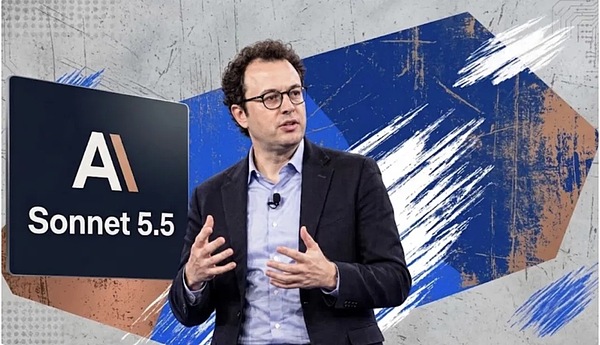
Only a week after the launch of the flagship model Claude Opus 5.5, Anthropic brought with him the second product of Claude 5.5.
On 28 September, local time, Anthropic officially released Claude Sonet 5.5. As a master model for daily office and software development, Sonnet 5.5 further improved the speed of generation and mission implementation while maintaining the API nominal price.
According to official data,Sonet 5.5's output generation rate increased by more than 30%More meaningfully, the new model reduces the combined costs of individual missions by up to 30 per cent through less redundant reasoning and tools in a number of tasks requiring continuous use of tools and repeated steps.
Performance changes are also evident. In multiple software engineering, knowledge work and computer-operated benchmarking tests, Sonet 5.5 is close to or even exceeds the results of the Opus 5.5 partial test configuration.
Programmation capability has been significantly enhanced, with partial tests exceeding Opus 5.5.
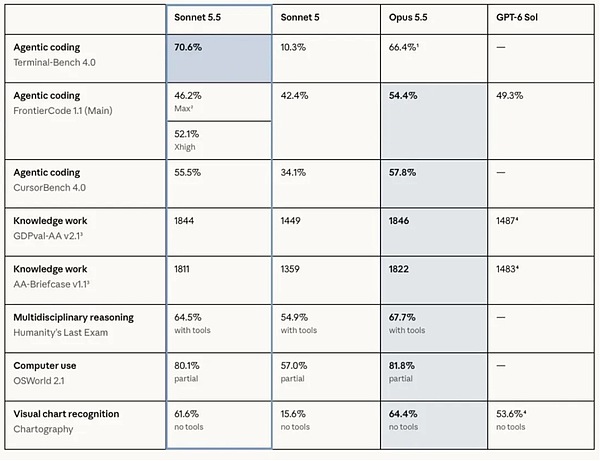
Anthropi official benchmark test comparison
From the official test results published by Anthropic, the gap between Sonnet 5.5 and the previous generation of Sonnet 5 is most evident in programming tasks.
In the autonomous smart body programming test Terminal-Bench 4.0, Sonet scored 70.6 per cent in 5.5, compared to 10.3 per cent in the previous generation. This performance was even over 66.4 per cent of Opus 5.5 published a week ago under the high-calculations range (Xheigh).
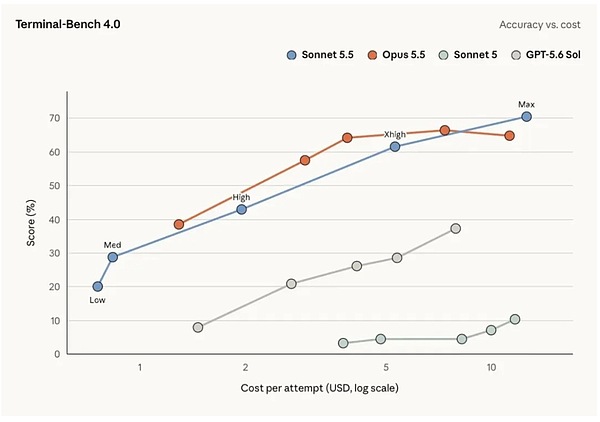
Terminal-Bench 4.0 Baseline Test: Model accuracy ratio versus call cost
In the real editor scenario test CursorBench 4.0, Sonnet 5.5 achieved 55.5 per cent, a significant increase from 34.1 per cent in Sonnet 5 and only 2.3 percentage points from 57.8 per cent in Opus 5.5.
In the high-intensity programming test FrontierCode 1.1, Sonnet 5.5 achieved 10 percentage points more under High effort than in the previous generation, while operating on a single mission cost about one-fifth of Sonet 5.
The performance of the knowledge work area is similarly close to that of the flagship model.
In the GDPval-AA v2.1 test, covering 44 occupations, Sonnet 5.5 scored 1844, which was higher than 1449 in Sonnnet 5 and 1487 in OpenAI GPT-6 Sol, almost equal to 1846 in Opus 5.5.
In the tool model of the interdisciplinary reasoning test Humanity's Last Exam, Sonnet 5.5 achieved 64.5 per cent, up from 54.9 per cent of Sonnet 5, and only 3.2 percentage points from 67.7 per cent of Opus 5.5.
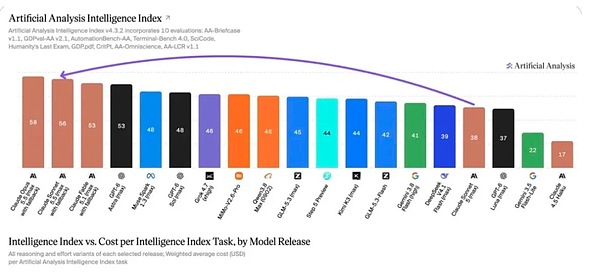
Artificial Analysis Smart Index ranking: Claude Sonet 5.5 score of 56
A similar trend is evident from third-party assessments. Data from Artificial Analysis, a large model assessment platform, shows that Sonnet 5.5 scored 56 points in its “Agent Index” (Artificial Analysis Inteligence Index), only 2 points below Opus 5.5; under the highest debrillation effort model, it scored 18 points higher than the previous generation of Sonnet 5.
Computer performance has also improved significantly. In part OSWorld 2.1, the Sonnet 5.5 accuracy rate reached 80.1 per cent, compared to 57.0 per cent of Sonet 5, which is not much different from 81.8 per cent of Opus 5.5.
With regard to visual understanding, the accuracy rate of Sonnet 5.5 in Chartography ' s toolless model increased from 15.6 per cent to 61.6 per cent in the previous generation, exceeding 53.6 per cent in GPT-6 Sol and close to 64.4 per cent in Opus 5.5.
However, the reasoning input is not as high as possible.
In the Frontier Code test, the Sonnet 5.5 score was 46.2 per cent under the highest arithmetical level (Max model), which is lower than 52.1 per cent under the next high level (Xheigh mode).
Anthropic explained that the Max model gave the model the highest degree of reasoning freedom, but this made it easier to trigger frequent code reviews and split sub-tasks; in part of the scene, overthinking led to mission time overruns or out-of-scope code changes that ultimately affected test results.
This result also indicates that, in intelligent missions, additional reasoning and implementation steps do not necessarily lead to higher mission accomplishment levels, how to control the calculation and execution paths, and are equally part of model optimization.
More work with less Token.
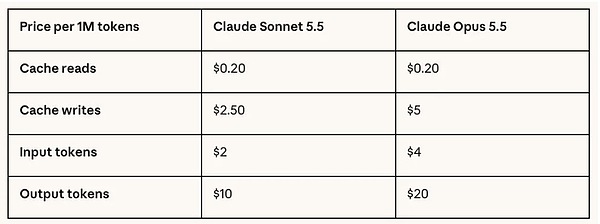
Claude Sonet 5.5 compared to the API official pricing of Claude Opus 5.5
The more noteworthy change in Sonnet 5.5 compared to performance improvements is the cost structure.
The input, output and caches of Sonnet 5.5 are half the value of Opus 5.5.
Its input price is $2 per million Token and its output price is $10 per million Token, at the same level as GPT-6 Sol.
By contrast, the input price for flagship Claude Opus 5.5 was US$ 4 per million Token, with an output of US$ 20; the lightweight GPT-6 Luna price was further reduced to US$ 0.1 per million Token and US$ 0.5 per million.
Thus, this time, Anthropic has emphasized not just how much “token per million”, but how much token, how many tools and how long it takes to complete a mission.
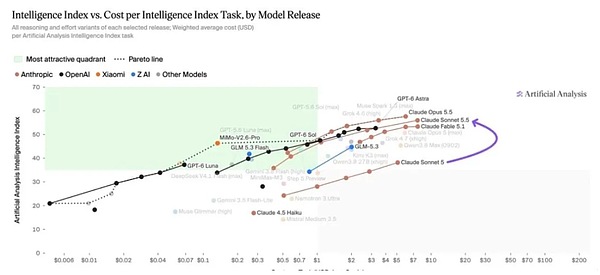
Smart index versus single job cost chart: Sonet 5.5 while maintaining high intelligence score, significantly lower single task costs
The Smart Index and Single Cost Chart, published by Artificial Analysis, also shows that, although the number of individual tasks exported to Token is high, the cost of a single mission remains low because of its efficiency. This means that for the Agent mission it is difficult to fully reflect actual usage costs by simply comparing prices per million Tokens.
While keeping the underlying price constant, Anthropic emphasizes that Sonnet 5.5 can reduce actual mission costs by reducing mission implementation steps and redundancy of reasoning. More frequent batching tools are called upon, which will also help to reduce the additional cost incurred in Agent's execution.
In an interview with the CNBC, Theo Chu, the research product manager of Anthropic, stated that Sonnet is primarily aimed at clients who are more cost-sensitive but do not need a top level of intelligence. Users do not necessarily need Opus-level in-depth judgement skills for a large number of routine and repetitive tasks.
It also makes the product division between Sonnet 5.5 and Opus 5.5 clearer: the former focuses on the efficiency and cost of a large number of missions, while the latter carries out tasks that require greater complexity and judgement.
On this basis, the cache of hints further reduces the cost of repeating tasks. Anthropic provides up to 90 per cent discounts for the cache of hints, and actual expenditure may fall further for developers who need to process the same context or long files over time.
Some early test feedback indicated that Sonnet 5.5 performed better in tasks such as re-engineering the user interface, generating presentations according to established templates and producing results with fewer manual modifications.
Security has been upgraded.
As model code capabilities and smart body implementation capacity have improved, safety issues have become an important component of the sonet 5.5 upgrade.
Anthropic states that, as a result of Sonnet 5.5 ' s significant improvement in its capabilities for network security and penetration testing, the model became the first to be published using the Sonnet model of a network safety protection mechanism at the same level as Opus 5 and Fable 5.1.
One such mechanism is the reorientation of high-risk requests.When the system identifies high-risk cyberattacks or infiltration requests, tasks are transferred to Sonnet 5 for processing, while avoiding any impact on normal software development and gap repair.
The second is the extraction of protective taxonomics for model distillation data.Anthropic wishes to reduce the risk of systematic replication and extraction of internal capabilities of models through large-scale API queries by competitors or malicious teams.
In addition, Anthropic highlights compliance and privacy capabilities. Sonet 5.5 meets the requirements of the EUAA-related watermarks and continues to provide zero data retention options in AWS, Google Cloud, Microsoft Azure and Anthropic Official API channels.
For Anthropic, enhanced modelling capacity is accompanied by simultaneous upgrades of security controls.
Haiku 5.5 is coming in.
With the release of Sonnet 5.5, Claude 5.5 product line in Anthropic has become more clearly divided.
Opus 5.5 is responsible for complex reasoning, in-depth judgement and difficult tasks; Sonnet 5.5 takes on day-to-day tasks such as software development, office automation and a large volume of intelligent work to be performed on a continuous basis; and Haiku 5.5 will further cover high-intensity, low-cost lightweight tasks.
Anthropic confirmed in an official communiqué that Haiku 5.5 would be launched in the coming weeks.
From the layout of this product, Anthropic is expanding the differences between models from simple capability to task type, implementation efficiency and use costs.
The emergence of Sonnet 5.5 also led to a clearer division of labour between Claude 5.5 series products: Opus continues to take on difficult tasks, Sonet is responsible for larger-scale daily work and Haiku covers more speed and cost sensitive scenes.
For Anthropic, the next competition will also shift from a single model to a combined race between model performance, implementation efficiency, and use costs. Sonet 5.5 can build on this idea to expand enterprise user size further and also to see how it behaves when it enters a real production environment.

 0

Statement: The present paper was written by the author of the gold-based financial estate, whose views are expressed only on behalf of the author and in no way represents the gold-based financial system which shares his view or confirms his description.
This information is not a financial investment proposal.
 Save


- Claude Sonet 5.5 released: Performance approaching Opus 5.5 halved prices, safety upgrades.
- The GPT-6 family has a new OpenAI price war, but it's not all about prices.
- XAI officially released Grok 4.7, still missing the top-of-the-generation model.
- The memory price is burning, and the chip war is back on.
- Wong In-hoon to the left, Amordi to the right.
24-hour text


 After $387.5 million was stolen, Bitget and thorchain got in a fight.
Conflux Tree Map blockchain



 How did the harvest line at the Meme Factory come out of the water, Robinwood Chain?
Chain catcher ChainCatcher
 Bitcoin goes into shock and waits for a new catalyst?
Knight of the Zone Chain.


 US SEC Committee member: Is the more regulatory data collection the better?
Asia-Pacific Future Study
- Seeking coverage
- Jinse Finance AppiOS & Android
- Community
Telegram - Feedback
- Back to Top
- Back to Bottom