

 Android & iPhone
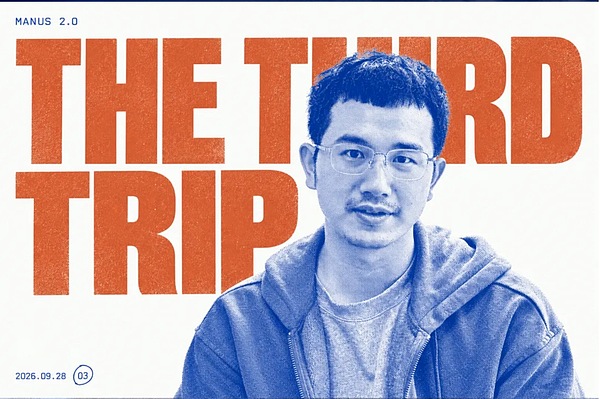
Manus 2.0 on line. Shaw Hong's third departure.

Watching
Just now
This post is part of our special coverage Libya Protests 2011.
September 28, Manus 2.0 on line.
The version was actually completed in August. It was stuck in a drawer for two months, until the huge cross-border acquisition of $2 billion was completely closed and it was possible to see the sky again.
Over the past nine months, Manus has experienced a rare story in China’s history of investment, first bought by Meta for more than $2 billion, then stopped by the National Development Commission, and finally redeemed at the original price by a group of older shareholders led by Quest.
For the vast majority of start-ups, these nine months are enough to hurt.
Manus is running faster in the middle of the storm. In the three months it was investigated and reorganized, its daily income increased almost fivefold, while less than three weeks after regaining its freedom, it was negotiating a new round of financing valuation that had reached about $4 billion, twice the return price six months ago.
The independent company came back to the table, and it was worth more than selling a giant.
And just 20 days before Manus 2.0 was released, Meta went online with her personal agent product Muse and hit the top of the US App Store free list in 10 days. What Muse is doing now, Manus has actually started to make a start in the months that Meta did.
Just this once, Manus has to finish it on his own.
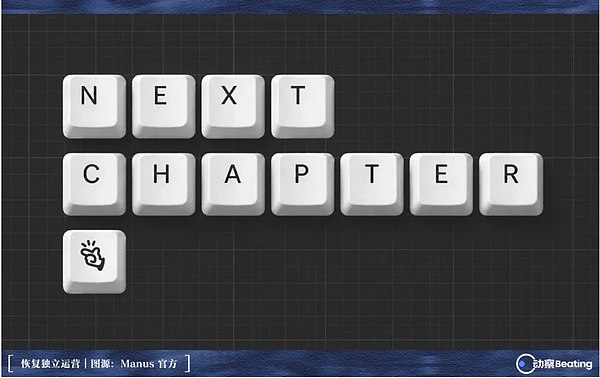
Manus 2.0
When the restoration of independence was announced on 1 September, Manus issued three military writs to himself: to embed angent more deeply into the daily workflow of users, to interact more directly with the real environment and to act more proactively when authorized.
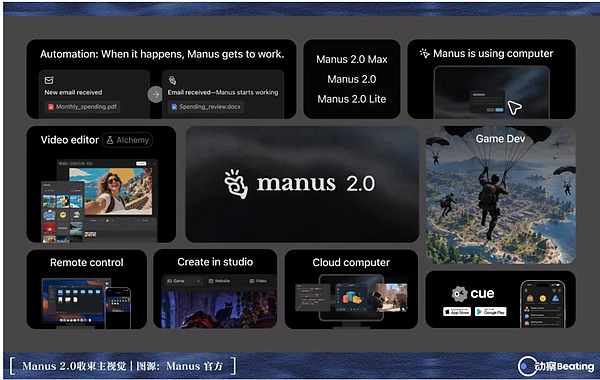
Four weeks later, 2.0, almost a three-story roll.
The entire bulletin is silent on Meta, and it does not speak of the past year’s upheaval. Its focus is to move the definition of an individual from a “work-for-work” to a “delivery of work”.
A year and a half ago, the team was famous for another experience: users threw away in one sentence, clouds automatically pulled up a virtual machine, searched information, knocked codes, ran data, and returned one result. If users are not satisfied with the resulting video mix, they tend to push back and rerun the prompt again.
Manus 2.0 chooses to return the process.
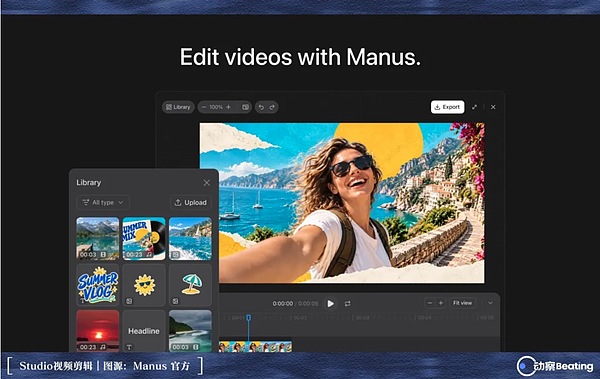
The new video editor is a few minutes to start cutting, and then spreads the time line. The clips, pictures, text, dynamic graphics and audio are independent materials that can be replaced with a mix, put into their own product maps, move animated, turn back Manus on the relay. And another model called Alchemy, it acts as creative director, while dispatching video generation and code engines.
The same is true of the game development environment. It connects video, image and programming models. If a villager’s hair should not be brown in the picture, then click on this village to correct it alone, and the rest of the logic and fine arts assets remain intact. A good game can be posted not only as a web page but also online for many people, just by checking out a cloud computer, server architecture, network penetration and bottom transport, all to go backstage angent.
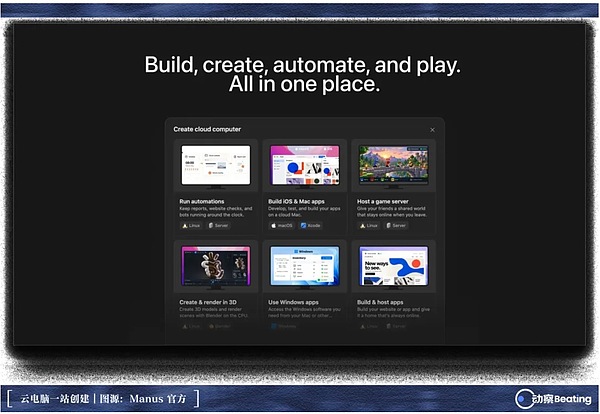
Embedded work streams rely on cloud computers and automation.
The cloud computer is the core infrastructure that has been added this time, a machine that has 7x24 hours of permanent presence in the clouds even if the user fits the notebook. It serves as both a server for multiplayer games and a permanent node for complex missions.
At the same time, automation has also moved away from mechanical time-shifting and a full-scale shift to event-driven, with a new entry mail, an inverted ad input data, and a specific Slack message that can awaken the entire chain instantaneously.
Interacting with the environment, it was handed over to Computer Use.
Imagine you're sitting in a taxi, giving a signal to your cell phone, Manus will take over the home computer desktop remotely, pick out the latest presentation in the launch folder, and the end even sees the trajectory of the cursor moving in real time. All this is strictly isolated from an independent and visualized workspace, only touching the application for which it has been explicitly authorized.
This was achieved by the new framework Cascade. According to Manus, it remained extremely light during the initial phase of the project, with professional models mounted on demand only in case of bottlenecks. In benchmarking tests, this system reduced token consumption by 23.2 per cent compared to the old structure, 28.2 per cent less time-consuming tasks and 32 per cent more than the combined operating costs.
As for "doing something more proactively", it was packed into an independent new product, Cue.
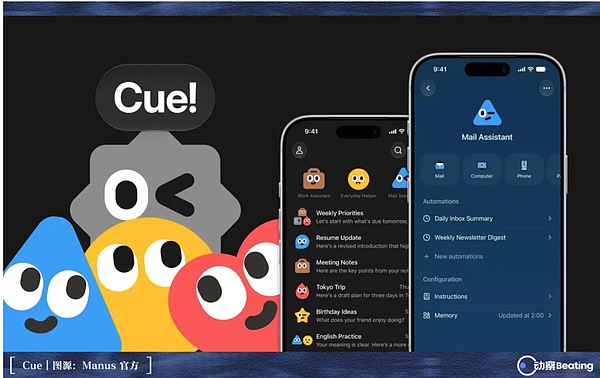
It's got both a cell phone and a desktop, sharing the same infrastructure as Manus. Each delegate has his or her own mailbox, telephone number, wallet and computer, can send messages, can pay within the user ' s established budget, can answer the phone and leave a summary of the call. A few delegates can be drawn into the same group, led to a common goal, a research venue for the New York launch, a list of candidates and a third draft presentation. Cue also needs to experience free of charge with the invitation number.
So, Manus' business chart was cut into two clear pieces. Studio was in charge of making things and Cue was in charge of running errands for people.
Ten days.
Manus's journey is traced back to a seemingly flat browser plugin.
In 2022, Xiao Hong created the butterfly effect, pulling through the season and Zhang Tao. The first product, Monica, put a big model into the sidebar of the browser.
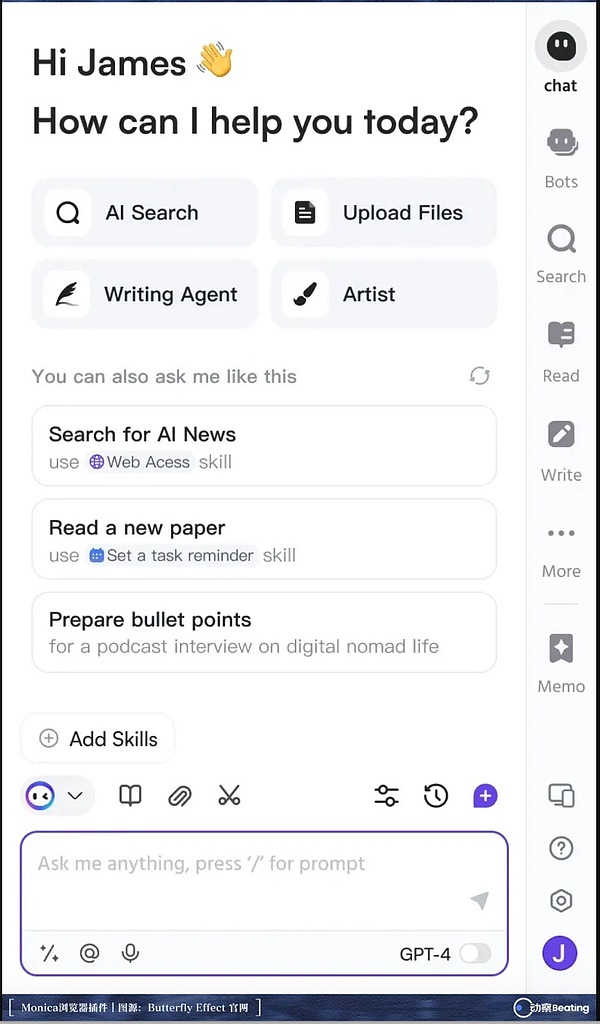
It was a period of grotesque in the cracks of the plant. When most people in the industry were still working on the exact cost of calling a single API, they were already doing a super-consumptive Wide Research, and the logic behind it was that there was a high bet that token costs would eventually depreciate at the speed of Moore’s law.
On March 6, 2025, Manus was officially released.
It took just 20 hours for a demonstration video to be played in millions, and the internal invitation code to be carried up to five digits on a used trading platform.
In July of that year, Xiao Hong decided to leave the long-standing Wuhan and move to Singapore with a core class. Since then, Manus has placed his strategic focus fully at anchor overseas.
Singapore gave Manus a good day.
By the end of the year, the company had offices in Singapore, Tokyo and San Francisco, expanding its team to 105 people. On December 17th, 2025, official disclosure that it had been on the line for only eight months, ARR had crossed a $100 million level, accounting for more than $125 million in run-rate payments; cumulatively, 14.7 trillion tokens were digested and over 8 million virtual computers opened in clouds.
It says that it's the fastest start-up company in the world from 0 to 100 million dollars.
At that time, the team was launching a new round of equity financing with an estimate of around $2 billion.
Meta's people were standing at the door right now.
At first, Meta gave the idea of a senior executive visiting to discuss depth cooperation at the operational level. After several rounds of contacts, however, in a closed-door meeting attended by all core members, Meta filmed an acquisition offer on the table without warning.
From the initial contact to the signing of the agreement, it was only ten days before and after.
Soon enough, Liu Yuan, an angel investor and partner of the Jing Foundation, confessed afterwards that because of his pacing, "even once suspected it was a false offer".
On December 29, Manus announced that more than $2 billion had been added to Meta. This was the third largest acquisition transaction in Meta’s business history after whatsApp and Scale AI.
From the $14 million valuation of genuine-solded seed wheels in February 2023, the book return has increased more than one hundred and forty times over a period of less than three years.
The early partners and engineers who were with Xiao Hong through their many start-ups finally got a big exit chip. People at the time saw this as an impeccable exit.
Mens et Manus
The name Manus, from the MIT Academy of Technology, Mens et Manus, brain and hand.
The chief scientist over-explained, smart enough to internalize the environment into himself. To deal with the real world, he needed a hand.
Manus wanted to do exactly what that hand did.
And at the end of 2025, Meta, it was this hand that was missing.
That year, Zuckerberg took out 14.3 billion dollars in stock, scale AI, dug up Alexandr Wang to take over the newly formed Meta super-intelligence lab and opened a world-wide bid in Silicon Valley for top scientists. At this end of the brain, Meta is reshaping the line at no cost.
However, it does not always have a killer app that can actually perform end-to-end assignments for users and independently generate software subscription income.
In an official blog that announced its accession to Meta, Manus wrote that he was looking forward to bringing this technology to millions of businesses behind the platform and billions of ordinary users.
B-end integration moves very fast.
At the press conference of 28 January 2026, Zuckerberg deliberately set aside time to evaluate the progress of the acquisition, stating that a considerable number of businesses were paying for it and integrating it into advertising and commercial packages, providing closed-ring programmes for ecological customers.
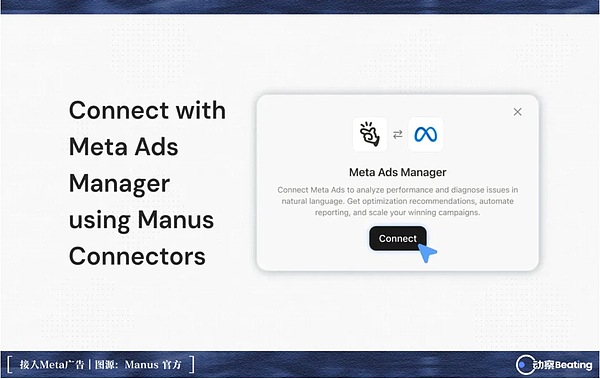
After three weeks, all Meta advertisers can call Manus directly in Ads Manager’s toolbox to produce post-delivery diagnostics. From contracting to business integration, it takes only seven weeks.
The capacity of the C end is also in the dark.
In mid-February, Manus was a stand-alone individual at Telegram, ant; In March, the team began to prepare for whatsApp Business. The technology owners quickly realized that the Meta Ray-Ban smart glasses support voice callers for whatsApp, and once this power is in place, the user will be able to put his hand on the mirror leg and wake up the farthest Manus who handles real affairs for himself.
As of March, about 100 Manus employees had moved into the office building at Meta Singapore headquarters.
Also in March, Xiao Hong and Qiu received a call from Beijing.
Avoidance orders
Boots are in fact already half-empty.
On 8 January 2026, one week after the announcement of the merger, the spokesperson of the Ministry of Commerce of China made it clear at a regular press conference that activities involving foreign investment, technology exports and cross-border M & As must be strictly subject to statutory review procedures and that the relevant authorities would conduct an assessment of the consistency of the transaction with national export controls and other regulations.
In late March, Xiao Hong went overboard with the arrival of the season and was subsequently restricted from leaving the country.
On 27 April, the Office of the Foreign Investment Security Review Mechanism of the Commission issued a final circular: “A decision to ban investment in the foreign acquisition of Manus project and to require the parties to cancel the acquisition transaction”.
In the view of cross-border legal circles, this is China’s first case of stopped foreign investment mergers and acquisitions on the AI front track since the introduction of the Foreign Investment Security Review Scheme in 2020; more specifically, there was no precedent for mandatory dismantling of mature transactions that had already been delivered.
According to an internal memorandum seen by Bloomberg, Meta has asked departments to discontinue all new Manus-based project development and move existing data to self-study systems; since then, the Manus team has been completely cut off from Meta’s internal powers and Meta employees are no longer allowed to use Manus’ internal tools.
A marriage that seems to be a happy one is marked by an end in itself.
The original price is redeemed.
The wind didn't make Manus stop.
In the three months that have been caught in a compliance saw, Manus has dramatically increased from $300,000 to nearly $1.5 million per day; during this period, his ARR first broke the $300 million threshold. There is also much optimism about the calibration given by the media, which has collected between $400 million and $500 million annually.
Product development has almost maintained its iterative resilience once or twice a week. Teams have not been eager to upgrade large-scale versions, and they are focused on key nodes, accessing Gmail, Shopify, Slack, advancing local clients, and finalizing ecological interconnectivity with Canva, Zoom, Notion.
One-hundred and one-hundredth of the people who started a business team, none left. Xiao Hong, Zhang Shuu and Zhang Tao stayed in Beijing, with daily cross-border video links that controlled the Singapore team’s pace.
The direction of the first-tier market has changed dramatically.
When the takeover was initially halted, many VCs were too scared to do so; but in mid-year, when strong business data was flowing again, hot money began to line up and wait for participation in the first round of financing after it had left Meta.
The old shareholders took the lead.
In June, a consensus was reached between Redwood China, Jingo, and Teng, which planned to redeem the company at the $2 billion that Meta had initially paid. In July, the announcement further clarified that it would take on a larger share of funding.
It is interesting to note that Benchmark's name has been obscured in the list of investors.
This former lead investor eventually chose to give up the buy-back, and its original share was pushed to the bottom. When the deal was settled, it jumped to Manus’s largest external shareholder, but remained in line with minority equity principles and did not gain ownership, while the company’s registration and business axis remained in Singapore.
Late in the night of August 11th, Manus Network quietly removed the Meta logo and replaced it with a sign that it was about to resume independent operations. Because of compliance requirements, some incremental data generated during M&As must be cleared first and then pulled back manually from the backup end by users.
On September 1, Manus announced the official resumption of independent operations, and Xiaohong, Qianxi and Chang Tao continued to lead. It gave themselves a new label, an "independent anent laboratory".
More than $2 billion in capital turned around over the books: it was distributed by giants to founders and financial institutions, and eight months later, Chinese capital took the lead and returned to the giants.
The price hasn't changed, the things we bought have changed.
At the time of acquisition, $2 billion corresponded to $100 million ARR, with a premium of up to 20 times; and at the time of repurchase, between $400 million and $500 million ARR had reduced its real valuation by four to five times as healthy.
In mid-September, Bloomberg exposed that Manus was pushing for a $500 billion new financing, with total post-investment valuation going straight up to $4 billion. IDG capital, well-rounded capital and the Nind era of new faces were on the line, and old shareholders were interested in following up; at the same time, red-bracket restructuring to be listed was on the agenda.
It would take only three weeks to double the original price from redemption to valuation.
The mirror enemy.
Meta on the other side of the ocean has not slowed down for a moment.
As early as January 2026, the month after the acquisition was just finalized, Nat Friedman, head of the SuperIntelligence Laboratory product, experienced OpenClaw in his workstream. Friedman revealed on social media that he had added hundreds of Mac Minies to the team, all of whom went into deep immersion.
On March 23, Meta also brought the entire team of angent Enterprise Dreamer into a super-intelligence laboratory, including Hugo Barra, former Vice President of millet Global and Stripe CTO David Singleton.
Zuckerberg spoke of this technology in an undisguised manner at the quarterly performance meeting at the end of April, when local agents presented the prototype of the future but used too high a threshold to require terminal configuration, independent hardware and cumbersomeness, with no immediate audience beyond hundreds of thousands of binoculars; Meta’s destiny was to create industrial products that were open-to-boxed, fully covered by cloud infrastructure and reached billions of ordinary people.
By the second quarter of July, Manus was completely sealed. Instead, Zuckerberg had an intensive preaching to 7x24 hours of autonomy.
September 8th, Muse was born out of nowhere.
The system has been assigned to a unique cloud host called Muse Security VM, with a security on the ground and full-scale inspection by ant Sentinel. It knows how to manipulate web pages, fill in vouchers and negotiate for clients, even staying backstage execution after App has withdrawn, while clearing lanes are linked to the payments component of Stripe. With a free quota of 100 million tokens per week, Muse quickly stepped up the American Applied Shop and helped boost Meta ' s single-month market value by close to 30 per cent.
Subsequently, the extremist community found that the Muse configuration to define the interactive boundary, SOUL.md, had a code structure almost identical to OpenClaw. In response, Friedman responded that while the system was rewrited by a team, product design was “surely inspired by it”.
Inspiredness may be attributed to open-source communities.
But Zuckerberg used to level the threshold by distributing an exclusive virtual machine in real time for billions of users on the cloud, precisely Manus, who spent the last two years doing the best he could. As early as 2025, this small team had deployed over 80 million cloud computers.
Manus, an independent intelligence body with a hardware identity, a communications tool and a human remodelling of the external reality, was able to build up his skeleton in February.
Meta copied the chain with a strong engineering capacity, while capital markets used 30 per cent of the stock price increase to set their prices.
It's just that this road has never been a straight path. Within two weeks of getting on the line, Amazon has stopped Muse from crawling and reporting, with its core concern being that he did not declare his identity and that there is a risk of over-authorization of historical assets.
Angent, who works for others, is often first hit not by his own technical ceiling, but by the ecological fence of others.
Cue was released 20 days after Muse went online.
The starting point for both products is almost the same, giving each angent a computer to do business with the outside world. But Cue chooses to go further on the reality interface: it prepares original telephone numbers and independent prepaid accounts for angent, able to answer voice calls, summarize calls, and settle accounts.
Behind it is an independent company that earns more than $300 million per year, with products in week-to-week shapes, and has just used the Cascade framework to charge 32% of the cost of reasoning. Unlike the competition for a single giant, Manus has chosen from the first day to move around multiple open-source and closed-source models.
For it, this is not the first time that a co-competition has been faced with giants.
At the beginning of 2025, when Manus first appeared, at least seven pixel-level alignment projects were set up within a large domestic technology plant, but none of its users was taken.
Third journey.
After the storm had been suspended, the real test returned to the bottom of technology.
Over the past six months, the team has completed a desktop eco-planning model that is essentially a standard paradigm for passive pursuit of Claude and Codex. After the equity relationship was clarified, strategic choices across management became sharper. Whether to continue to fly intuitively on sensitive product engineering, or whether to end up with heavy asset muddyings of large models pre-trained?
Xiao Hong once summed his business methodology as "trade technology" by setting up an ecological dividend, then refining product matrices, and finally anti-bottom techniques. With this campaign, the first two steps are clearly complete.
Just after New Year’s Day 2026, the day after the merger agreement was signed, Sho Hong had wandered along Singapore’s coastline alone. On the other hand, he thought that this ten-year run had finally ended under the roof of a giant, and then went to work in a big factory, but his heart fell short.
Instead, the hammer that the regulators called off the deal has rekindled into the eyes of the tired and successive entrepreneurs.
In an in-house conversation with the entire staff, Xiao Hong stated that he would not be willing to turn into a bystander and recorder of this era. Only when it comes to entrepreneurship is there any meaning to have to be caught up in a raging stream.
On the night of August 11th, in a letter to the team and management in English, he wrote:
「This is my third trip.」
He started his business twice before that. In 2015, when Wahko graduated, he left the market five years later in Wuhan, and in 2022 he re-established the butterfly effect, killing Manus’s blood from Monica.
At this moment, the signal of departure for this third journey is dramatically back to square one.
On September 28, Manus announced that Manus 2.0 was back online in the country’s social media. The circular stated that 2.0 was available to overseas users; companies were forming teams to develop products for the domestic market, and cooperation with national production model manufacturers was proceeding steadily.
More than a year ago, Manus emptied his own microblogging and little red book.

 0

Statement: The present paper was written by the author of the gold-based financial estate, whose views are expressed only on behalf of the author and in no way represents the gold-based financial system which shares his view or confirms his description.
This information is not a financial investment proposal.
 Save

24-hour text


 After $387.5 million was stolen, Bitget and thorchain got in a fight.
Conflux Tree Map blockchain

 How did the harvest line at the Meme Factory come out of the water, Robinwood Chain?
Chain catcher ChainCatcher
 Bitcoin goes into shock and waits for a new catalyst?
Knight of the Zone Chain.

 US SEC Committee member: Is the more regulatory data collection the better?
Asia-Pacific Future Study
- Seeking coverage
- Jinse Finance AppiOS & Android
- Community
Telegram - Feedback
- Back to Top
- Back to Bottom