

 Android & iPhone
What's the change in the final version of the Clarity Act?

Jinse Finance
2026/09/14 17:50 101,000
Todju, the gold fortune.
Summary:According to the journalist,Eleanor TerrettThe Senate Republicans released it.New version of the CLARITY BillThis includes a revised ethical proposal agreed to by President Trump, which also introduces changes in the Act on the Determination of the Regulation of Block Chains (BRCA), the provisions for the stabilization of currency gains and the provisions of the Agriculture Commission.
I. What has changed in the final version?
Senator Cynthia Lummis, John Boozman and Tim Scott, 14 September 2026Publication of a new edition of the CLARITY BillLummis stated that, after more than a year of bipartisan negotiations, the new text had completed 126 substantive changes proposed by the Democratic Party.
Compared to the previous version, which was published on 11 September, the final version of 14 September focused on four directions.
1. BRCA: Developer protection is further narrowed
The BRCA, the Blockchain Regulatory Certancy Act, has been a more controversial part of the CLARITY Act.
The previous version sought to make it clear that some blockchain software developers who did not control user funds should not be considered as carrying out money transmission operations simply because they developed, deployed or maintained the relevant software. But the problem was that such protection, if over-covered, might be understood as also protecting criminal liability.
The final text was significantly narrowed down.
According to the final version,The scope of the BRCA-related protection focused mainly on the Bank Secrecy Act (BSA) and civil law enforcement, which had previously been preceded by the deletion of language that might extend to criminal cases, including criminal prosecution protection in connection with 18 U.S.C. § 1960.
The new text further favours law enforcement between the protection of developers and law enforcement.
Article 1960 is sensitive because it involves criminal liability, such as the unlicensed operation of money transmission operations. One of the most controversial issues surrounding BRCA was whether developers could assume similar responsibilities to those who actually controlled funds by developing non-trust, decentrized software.
2. Ethical provisions
While the previous version mainly prohibited the President, members of Parliament, federal judges and their spouses from issuing or sponsoring certain digital assets during their tenures, Senator Thom Tillis of Democrats and Republicans argued that a mere ban on “distribution” was far from sufficient: if politicians were unable to issue Meme coins but could still hold heavily valuable crypto assets, conflicts of interest remained.
As a result, Tillis and Democrat Senator Ruben Gallego promoted a more rigorous ethical programme.
Based onAssociated Press.In the final version, Trump agreed to about 80 per cent of the content (mainly referring to the article on the State Attorney). The assistant indicated that an updated version of the bill, due to be published later on Sunday, would contain a requirement thatAny entity that issues cryptocurrency has a “significant” financial interest, which must either be severed or placed in blind trust.
Trump also agreed to include a provision allowing the Attorney-General of the Länder to prosecute the cryptocurrency exchange, if it had built up digital assets that were prohibited by the Act in its entirety.The White House has previously expressed concern that the DDPA might use this to popularize Republican officials against the Tran, if the State Attorney-General were allowed to directly enforce the relevant provisions; in turn, the Republican Attorney-General could also target Democratic officials. Thus, allowing the State Attorney-General to participate in law enforcement was in fact an important earlier demand of the Democrats, which was eventually accepted by Trump.
United States Senator Cynthia Lummis wrote on platform X that “after a year of intensive daily bipartisan negotiations, the bill is ready. President Trump voluntarily agreed to add a new ethical clause that would impose one of the most stringent ethical restrictions in United States history on all elected federal officials, judges and their spouses. This new text incorporates more than 120 demands from the Democrats. A negative vote on Tuesday would mean opposing real ethical reform of personal investment behaviour against politicians, handing over US leadership in the digital asset field to foreign competitors, and denying American citizens any protection in the digital asset market. The Democrats have met their expectations; Now they need to accept the bill and vote in favour. “...
3. Stabilizing currency gains
Stabilizing currency gains has been one of the most difficult issues for the CLARITY Act.
Traditional banks are concerned that if a stable currency provides the holder with similar interest earnings, funds may be transferred from a bank deposit system to a stable currency. The banking sector has previously expressly called for further restrictions on the mechanisms of the money.
Therefore, the final text was not simply “one size fits all”, but instead introduced what Senator Tillis had previously proposed.The “circuit breaker” mechanism: Federal regulators can intervene if there are signs of a massive loss of community bank deposits as a result of the stabilization currency. The final version further gives Minister of Finance Scott Bessent jurisdiction over the mechanisms.
4. Provisions of the Senate Committee on Agriculture: further restrictions on vertical integration
The updated text adds a more stringent guard around vertical integration.It also clarifies that state consumer protection laws are still applicable and that developers protect against the creation of derivatives law exemptions or influence forecasting markets.
The new text clearly emphasizes that:The state consumer protection law does not automatically lapse on the basis of the CLARITY Act.。
In addition, provision is made forDeveloper protection does not automatically constitute an exemption from derivative law and does not affect the forecast market.This was in response to earlier disputes over the regulatory boundaries around DeFi, forecast markets and derivatives.
II. Views of the industry
Nate Geraci, President of the ETF Store: It would be good if the CLARITY Bill were to get enough votes this week, but it is not considered to have a decisive impact on the future of the encryption industry. The United States Securities and Exchange Commission (SEC) and the Commodity Futures Trading Commission (CFTC), under the leadership of the Trump Government, can still use their existing competencies to promote the encryption industry. The encryption industry is developing at a much faster pace than the policy-making cycle, and it may be difficult to reverse this trend when United States political circles realize that the financial system has been upgraded. The CLARITY Bill will only serve as a further boost to provide clearer policy expectations for the encryption industry by increasing market confidence that innovation is not easily reversed, but the future of the encryption industry does not depend on its passage.
a16z crypto Policy Officer and General Counsel Miles Jennings: Some banks do not want the CLARITY Act to be passed into law. He had not seen evidence of what banks called "stabilizing money incentives that would lead to an outflow of deposits". Jennings believes that the "law enforcement instead of legislation" during the Gensler period may still continue to drive encrypted entrepreneurial activity away from the United States by simply using the executive actions of the US SEC to provide long-term certainty to the founders beyond their term of office.
Grayscale Research Manager Zach Pandl: Even without the CLARITY Act, the United States regulatory framework is becoming clearer in areas such as stabilization currency, token issuance, tokenized securities and sustainable futures. The two-party legislative proposal to establish a comprehensive set of rules for the encrypted money market, the CLARITY Bill, will face a crucial test in the Senate on 15 September: a vote to close the debate on whether or not the bill enters the plenary debate will require 60 votes, with the market predicting that it is less likely to pass by 2026. The U.S. has made regulatory progress in many areas: the GENIUS Act has established a federal framework for currency stabilization; The proposed regulations for the regulation of crypto assets and the rules on transfer agents will provide a clear path to token financing and monetization; CFTC has opened up regulatory channels for the renewal of futures through Kalshi and Coinbase. Grayscale argues that the adoption of the CIATY was not decisive, and cryptocurrency policy has advanced in many ways.
Patrick Witt, Executive Director of the White House Digital Assets Advisory Committee: The differences around the CLARITY Bill have now progressed and are optimistic that it will move forward. Witt says, "I feel pretty good about this."
Summary
The 14 September version of the CLARITY Act is clearly more mature than it was a few months ago. For example, there are “breakers” to stabilize currency gains; BRCA has added clear boundaries for criminal responsibility; ethical provisions have been added to major encryption interests sales/blind trusts; state attorneys-general have access to law enforcement space.
If the 53 Republican senators voted in favour of it, the bill could quickly enter the next phase if there is cross-party support within the Democratic Party for at least seven people. On the contrary, the bill may be stalled and, as the mid-term elections approach, if this election does not pass, the CLARITY Bill will face even greater variables in the future.
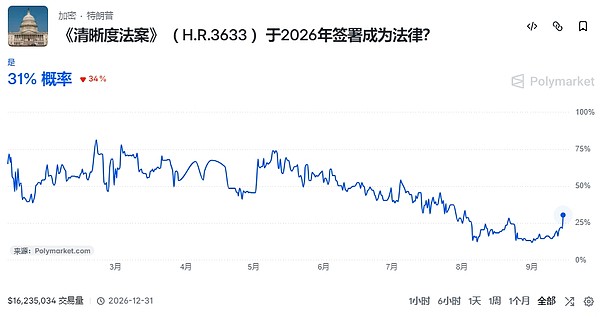
At the time of submission, on Polymucket, the probability that the CLARITY Bill would be signed into law in 2026 was considered to be 31%.

 8

Declaration: This is a gold original, the copyright is a gold one and cannot be reproduced without authorization. A copy of this article must be downloaded from an agreed-upon medium with the indication "Source: Gold Book", for which the offender will be held liable under the law.
This information is not a financial investment proposal.
 Save



- Pantera's latest status report on monetization.
- What game is AAVE playing next?
- US SEC issues an update of the crypto asset FAQ to add a new issuer's currency buyback definition
- QNT surged over 300% a week, currency deposits infiltrated the core of the United States banking system?
- Vitalik's latest post: The Ether Workshop will become a password-based world computer.
24-hour text




 Eight hidden details of Anthropic's book.
GenAI Summit
 Bitcoin goes into shock and waits for a new catalyst?
Knight of the Zone Chain.
 How did the harvest line at the Meme Factory come out of the water, Robinwood Chain?
Chain catcher ChainCatcher


- Seeking coverage
- Jinse Finance AppiOS & Android
- Community
Telegram - Feedback
- Back to Top
- Back to Bottom
I feel like I'm filling up.