

 Android & iPhone
Pons outbreak Robinhod Chain is becoming a new battlefield for Meme?

Jinse Finance
Just now
Todju, the gold fortune.
Summary:As Token Launchpad, a native of Robinwood Chain, Pons continues to inject large amounts of home-grown crypto assets and transactions through low-threshold currency issuance, chain trading, and liquidity mechanisms. Pons have recently grown rapidly, becoming an important asset distribution and flow entry point in the chain.
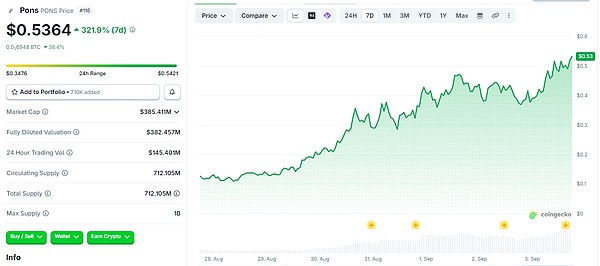
As at the time of the release, PONS had increased significantly, by 321.9 per cent on 7 days, reporting an amount of $0.5364.
I. Pons Overview
According toNetwork of officialsInformation, Pons is a non-hosting Token Launchpad that runs on Robinwood Chain, and users can create tokens directly through their wallets and complete transactions along the chain. Official documents show that the core location of Pons is “Launch and traded-supplely tokens on Robin Chain”, i.e. helping users quickly issue and trade fixed supply tokens on Robinwood Chain.
When coins are created, the tokens and their trading pools will be deployed through a single transaction, which will automatically lock on their liquidity. The creator will need to set up the name, symbol, image, description, link and wallet address at the time of creation. Each currency will be traded with WETH in its own trading pool. No curves will be tied and no subsequent migration will take place.
The transaction entails a liquidity fee, payable in both tokens and WETH. The agreement will retain part of it and the creator will keep the remainder.
When tokens are issued, their share shares are recorded separately and remain unchanged. The current 70/30 equity ratio applies to the currency that is issued through the current distribution channel.
Currently, manual buy-back operations are being carried out through automated TWAP using 80% of the protocol costs. This amount is not fixed at present, but will be immutable, decentrized and automated in future versions.
In sum, Pons is not a traditional centralized currency platform. Instead of charging assets to the Pons account, the platform arranges transactions, and it interacts directly with smart contracts on the chain through wallets.
II. Special features of Pons
1. Bonding the issuance of tokens and liquidity
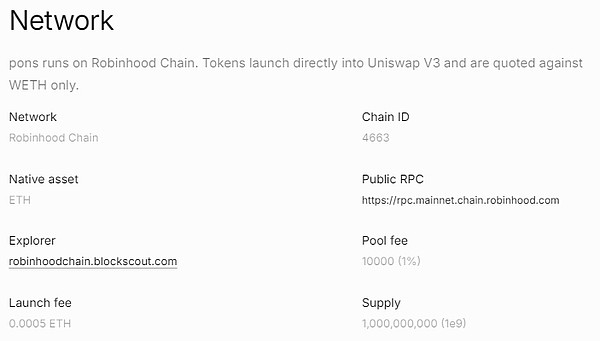
As can be seen in official documents: Pons are currently operating at Robinhod Chain, Chain ID is 4663, and the original Gas asset is ETH. The current version of token distribution will enter the Uniswap V3 mobility pool directly, using WETH as an offer asset. The pool transaction rate is currently 1%, and the cost of issuing 0.0005 ETH for creating a token is covered.
In Pons, the creation of new tokens will lead to a chain-based liquidity environment where transactions can take place and further lower user distribution thresholds.
2. Graduation Mechanism
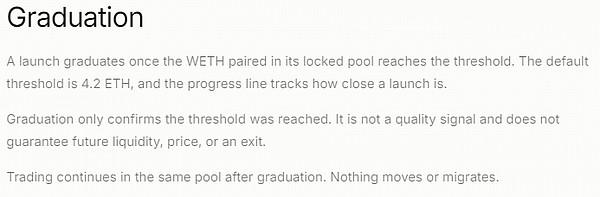
In the Graduation (graduation) section of the official document, Pons states that when a threshold of WETH is reached by locking in a matching pool, the project is completed. The default threshold is 4.2 ETH, and the progress bar shows the project ' s distance from graduation. “Graduation” only confirms that the threshold has been reached, does not represent project quality and does not guarantee future liquidity, prices or exit opportunities. After graduation, the transaction continued in the original pool without any transfer or relocation of assets.
Simply put, it is a recently issued token that was initially in the early stages of trading. When its liquidity reaches the predetermined threshold, the token enters the next stage.
3. Non-hosting
Pons emphasizes non-trust: “Pons will never freeze your funds.
For Launchpad, which is highly dependent on Meme and the community, such a design has advantages: on the one hand, the platform does not have to bear the risk of hosting the assets of users from traditional trading platforms; on the other hand, all transactions can be validated along the chain.
However, non-hosting does not mean that there is no risk. Pons also warns that Token on the platform may be highly volatile, under-mobility or even zero risk, and that users need to check their own addresses, creators, holding concentration and transaction information.
“A token issued through PON is created by the user and is in the experimental stage.
Price volatility may be rapid and liquidity may be inadequate.
Similar names and images may represent unrelated lines.
Smart contracts, wallets, RPCs and indexers can all fail.
The values shown are estimates and not performance assurance.
Pons is an interface that does not reflect the quality of investment proposals or tokens.”
iii. What did Pons bring for Robinwood Chain?
1. Intelligent asset distribution motive for ever
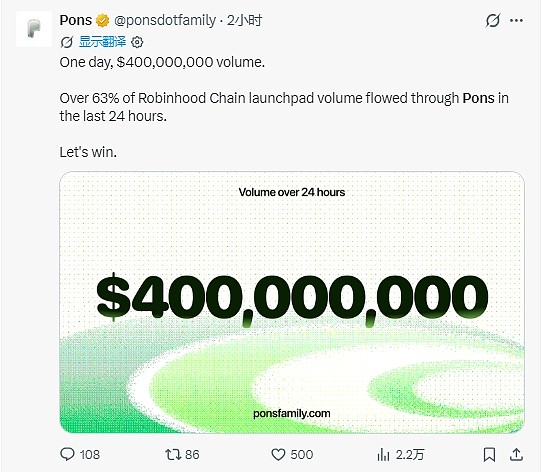
According to Pons in X:
Over the past 24 hours, its single-day transactions have reached $400 million, and more than 63 per cent of the transactions in the same period have been completed through Pons. Moreover, Pons ' cumulative trades have exceeded $5 billion, indicating that platform trading activities are continuing to grow.
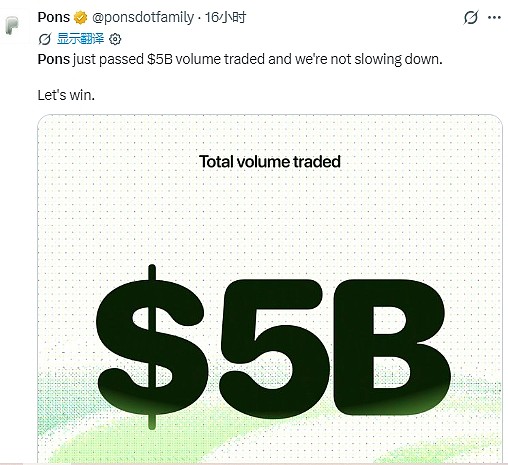
Pons are no longer just a small-scale currency issuer, but rather form an active market for the issuance of raw assets on the Robinhod Chain chain. And, as noted above, the threshold for Pons’ issuance is extremely low, with the creation of tokens paying only 0.0005 ETH.
Under this model, a large number of newly created tokens can enter the market in a short period of time. It is tantamount to creating a permanent incentive for Robinhod to constantly create crypto assets.
Trade on the chain is hot.
According to DeFiLlama, as of the date of issuance, Pons had accumulated some $4.08 million in fees over the past 30 days, realizing approximately $7.93 million in revenue, DEX transactions amounting to about $591 million and PONS market value of about $349 million. The Pons charges had erupted significantly at the end of August, with single-day charges climbing after 29 August, reaching a maximum of $6 million, and Pons ' recent trade activity has increased significantly.
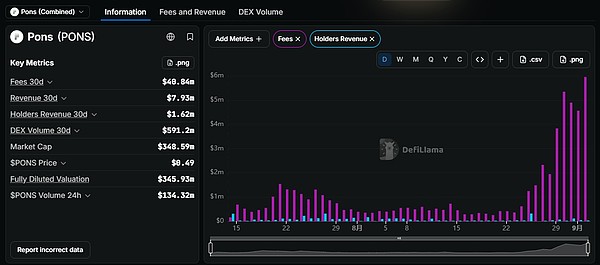
For Robin Chain, Pons not only created many crypto assets but also provided a large volume of transactions and liquidity.
3. Traffic entry
It is well known that Robinhod is a bridge between tradition and encryption, and Robinhod wants to bring traditional financial users gradually into the chain through products such as stock coins, ETFs and stabilizers.
Pons, through the very low threshold for issuing tokens, bring a large number of community coins, Meme tokens, to Robinhod Chain. Meanwhile, Robin Chain will attract more interest in agreements such as DEX, wallets, cross-chain bridges, DeFi, and stabilization money because of his improved ecology.
Details are available"A book that understands the ecological map of Robinwood Chain."
4. Partially poor assets
The issuance of large amounts of coins also means that there will be some poor assets. Pons bring crypto assets, mobility and users to Robinhod Chain, along with garbage coins, speculation, etc. If Robinhod can access quality projects, real communities and transaction needs through Pons, Pons may become an important entry point for primary assets of Robinhod Chain. But if Pons brings only short-term flows, then the long-term ecological value of Robinwood cannot be sustained.
Summary
Pons are not official coins launched by Robinwood, but the original Token Launchpad on Robin Chain and an important distribution point for meme and community assets in the chain, but they may also bring down some poor-quality assets.
For Robinwood, it may be more interesting to see how the short-term meme flow of Pons can be further transformed into long-term financial chain users.

 3

Declaration: This is a gold original, the copyright is a gold one and cannot be reproduced without authorization. A copy of this article must be downloaded from an agreed-upon medium with the indication "Source: Gold Book", for which the offender will be held liable under the law.
This information is not a financial investment proposal.
 Save



- Pantera's latest status report on monetization.
- What game is AAVE playing next?
- US SEC issues an update of the crypto asset FAQ to add a new issuer's currency buyback definition
- QNT surged over 300% a week, currency deposits infiltrated the core of the United States banking system?
- Vitalik's latest post: The Ether Workshop will become a password-based world computer.
24-hour text






 Eight hidden details of Anthropic's book.
GenAI Summit
 Bitcoin goes into shock and waits for a new catalyst?
Knight of the Zone Chain.
 How did the harvest line at the Meme Factory come out of the water, Robinwood Chain?
Chain catcher ChainCatcher


- Seeking coverage
- Jinse Finance AppiOS & Android
- Community
Telegram - Feedback
- Back to Top
- Back to Bottom